I’d really appreciate some advice from people who have recently gone through the Global Talent endorsement process. I’m Natalia Pazzaglia, a startup founder running a VC-backed social impact tech business, and I’m currently in the UK on an Innovator Founder visa. I’m now preparing an application to switch to Global Talent. I’m considering applying under TALENT, but I have two questions:
1. If you apply for Talent and the panel feels you don’t quite meet that threshold, can they assess/re-route the application as Promise instead? Or would they reject the application and require you to start again?
2. Would Talent be a reasonable route with around 4.5 years of founder experience in digital technology?
I founded my first tech-for-good startup in March 2022 and subsequently founded my current business. Before that, I had several years of experience in social innovation/startups, but with less of a direct focus on digital technology. I have evidence of years of founding and growing ventures, external investment, innovation, media/industry recognition, and commercial/entrepreneurial contribution, but my relatively recent start of a specifically digital-tech track record is what makes me hesitate between talent and promise.
I’d really appreciate perspectives from anyone who has applied recently, advised applicants, or faced a similar Talent vs Promise decision.
For the Talent vs Promise question, the key distinction is the level of recognition and track record rather than simply the number of years since the applicant entered digital technology.
Under the current Digital Technology criteria, Exceptional Talent requires recognition as a leading talent in digital technology in the last five years, whereas Exceptional Promise requires recognition as a potential leader and also requires the applicant to be at an early stage of their career. On the facts described, the 4.5 years of founder experience in digital technology does not by itself prevent a Talent application. The more important question would be whether the evidence demonstrates recognition at the level expected for a leading talent. Founder experience, investment, product development, innovation, media recognition and commercial/entrepreneurial contribution can all be relevant, but they need to establish the required level of recognition and satisfy the Talent criteria. For Promise, the profile appears conceptually aligned with the experience requirement because the digital-tech career is relatively recent. However, the evidence still needs to establish that the applicant is recognised as a potential leader and satisfy at least two of the specified Promise criteria.
Regarding your first question, I would not rely on the panel automatically converting a Talent application into Promise if Talent is not met. The published rules describe Talent and Promise as separate endorsement criteria, and the endorsing body decides whether the criteria applied for are met. If endorsement is refused, the applicant can request an endorsement review or make a fresh application. So, with 4.5 years of digital-tech founder experience, Talent is not excluded on experience length alone. The deciding issue is whether the evidence supports “leading talent” rather than “potential leader.” If the evidence is principally demonstrating an emerging but developing track record, Promise may correspond more closely to the published framework.
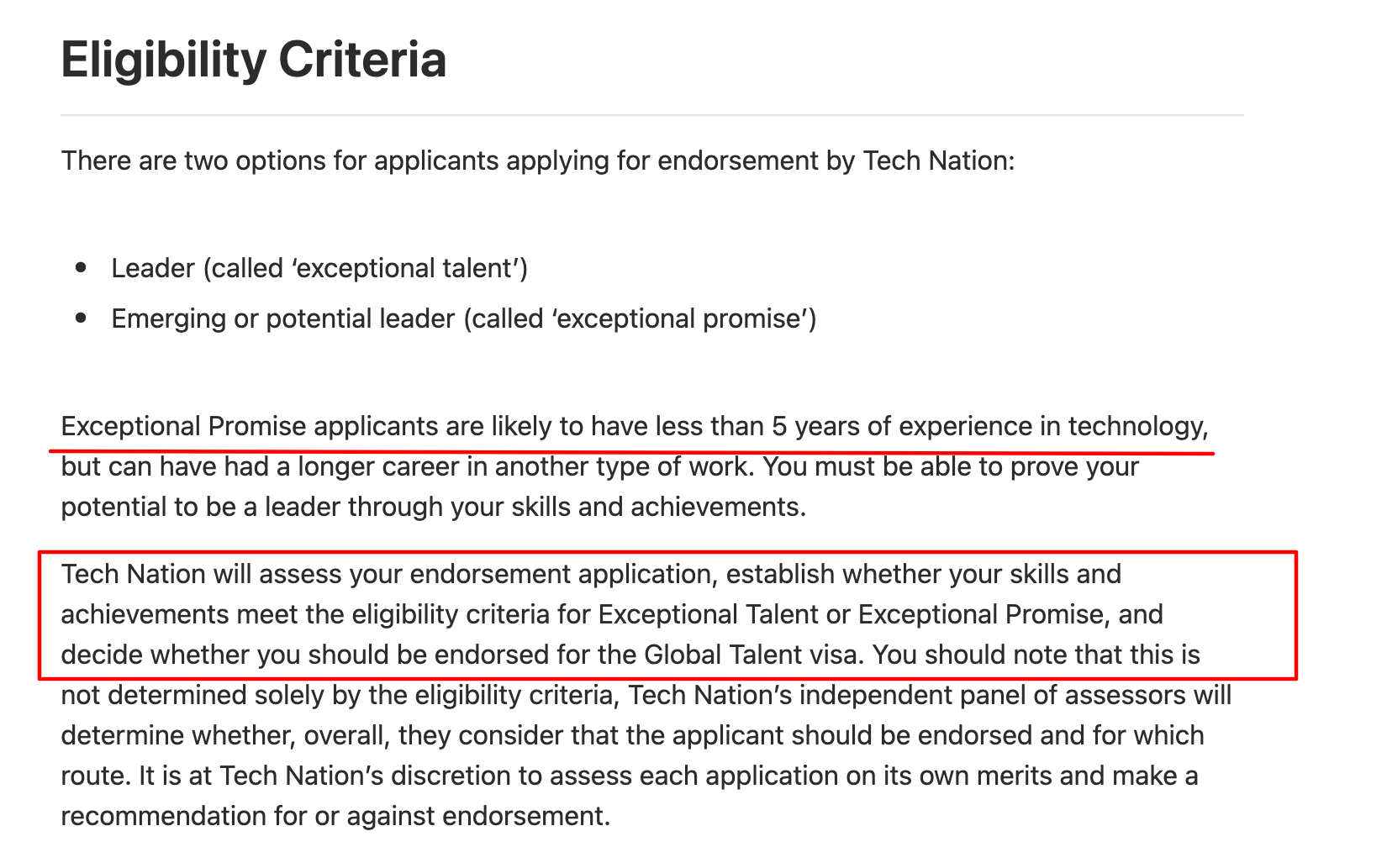
The major difference between the Exceptional Promise and Exceptional Talent pathways is the number of years of experience in the technology sector. As stated in the Tech Nation guidance:
“Exceptional Promise applicants are likely to have less than 5 years of experience in technology…”
Logically, because Promise applicants typically have fewer years of experience, they may not yet have accumulated the same level of achievements or industry contributions as Talent applicants, who generally have 5+ years of experience. As a result, the threshold for acceptance and demonstrating sustained impact may be lower for Promise applicants. We have also seen this reflected over time in endorsement outcomes and feedback.
That said, Tech Nation assessors still have the discretion to determine which category an applicant is best suited for, amongst other things and may endorse them under the pathway they believe most appropriately reflects the evidence provided.
Regarding your questions:
If you apply for Talent and the panel feels you don’t quite meet that threshold, can they assess/re-route the application as Promise instead?
Yes. Based on the guidance shown in the screenshot, assessors can consider whether an applicant is better suited to the Promise pathway if the evidence aligns more closely with that pathway.
Would Talent be a reasonable route with around 4.5 years of founder experience in digital technology?
With less than five years of experience, the Promise route would generally be a suitable option. However, the final decision should depend on the strength of your evidence and whether it demonstrates the level of impact expected under the Talent criteria. Strong achievements can sometimes justify a Talent application even with fewer than five years of experience.