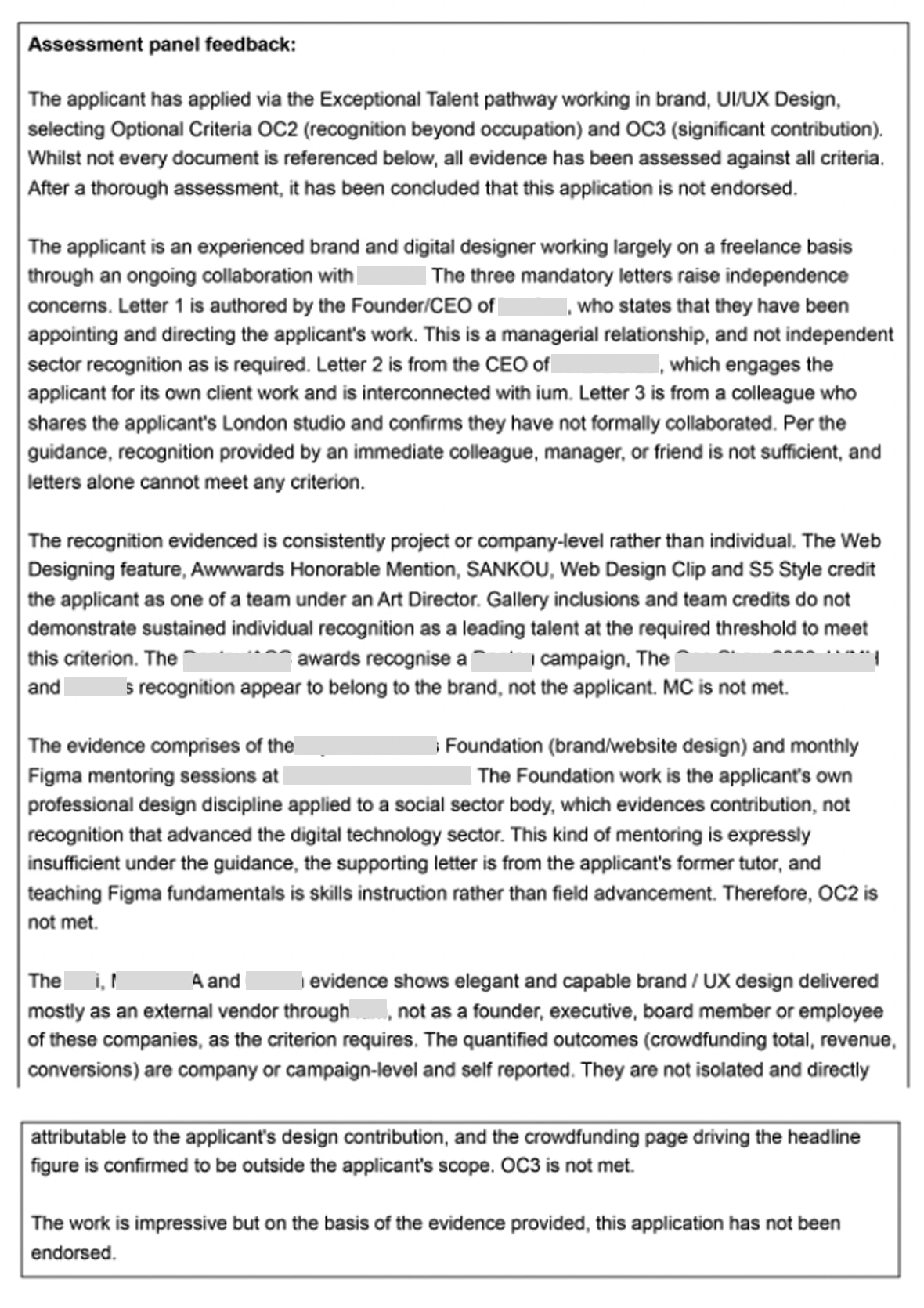
SUMMARY:
Unfortunately, none of the three criteria (MC, OC2 and OC3) were met. The panel questioned the independence of my recommendation letters, considered my awards and media recognition to be project- or company-level rather than individual recognition, and found that my contributions outside my occupation did not demonstrate advancement of the digital technology sector. For OC3, my role as an external design partner was also considered insufficient, and the commercial outcomes were not directly attributable to my individual contributions.
My main concern is that much of my career has been built around independent freelance collaborations rather than in-house employment. I’m now trying to understand whether the main issue was how I presented my evidence, or whether my professional background itself is a poor fit for the criteria.
BREAKDOWNS:
ENDORSEMENT LETTERS
Founder & CEO of a design studio I’ve collaborated with as an independent freelance designer
CEO of another design studio I’ve worked with on client projects
Independent creative professional based in London
MC
UX and design system development for a large-scale corporate digital platform (6,000+ pages)
Digital experience design for an award-recognised national government campaign
Long-term brand and digital design partnership with a fast-growing beauty technology company
Award-recognised digital experience design for an internationally recognised brand
OC2
Visual identity and website design for a non-profit foundation
Official recognition as an operating team member of a non-profit foundation
Mentoring design students at a leading UK art and design university, bridging academic learning and professional digital product practice
OC3
Brand and digital design for a consumer technology product launch, achieving ¥20.7M in crowdfunding
UX redesign for a personalised beauty subscription platform, improving conversion and subscription engagement
Development of a scalable brand and digital design system for a plant-sensing AgTech company
NEXT STEPS – SEEKING ADVICE
Given that none of the criteria were met, I’m trying to understand the best way forward. Would you recommend requesting an Endorsement Review, or submitting a fresh application with revised evidence? If I were to reapply, would it be more appropriate to apply under Exceptional Promise rather than Exceptional Talent?
If you shared a draft for assessment before submitting, it would be helpful to link it here so people can understand the chronology and compare the original evidence with the decision.
I would also consider requesting an endorsement review before reapplying. It is free, and although you cannot introduce new evidence, the review response is often more detailed and direct than the original refusal. This can give you a clearer indication of what needs to be strengthened in a fresh application.
I’m so sorry to hear about the rejection, Kumi. it’s can be discouraging , but I really want to encourage you to submit an appeal regardless of what the feedback says. At worst, it gives you much clearer feedback on where you stand, and in my experience, I’ve worked with several applicants who later got endorsed through the appeal process.
As for a new application, it’s a bit tricky to give tailored advice without seeing the exact evidence you submitted. That said, I usually recommend waiting around 3 to 6 months before reapplying. Use that time to directly address the rejection feedback and gather at least one strong, well aligned piece of new evidence for each criterion.
The refusal you summarise reads mainly as evidence-weighting and attribution. Request an Endorsement Review only if you can identify a specific processing error, such as evidence being overlooked or a fact misread. A review cannot add evidence or simply ask for a different assessment. If no specific error is apparent, build a fresh case around the gaps identified.
Freelance work alone does not decide whether your background fits Digital Technology. The Tech Nation Guide includes experienced UX/UI designers among typical applicants, while excluding consultancy and service-delivery profiles. OC3 expects significant individual contribution within a product-led digital technology company, so external collaborations need clear criterion fit and attribution. Referees should be established digital-technology experts with at least 12 months’ detailed knowledge of your work and independent assessments.
Talent requires recognition as a leader; Promise is for an early-career applicant recognised for potential. Both require MC and two optional criteria, so Promise does not fix the evidence gaps. Your post does not establish that Promise fits your career stage; choose it only if your digital-technology career is genuinely early. Otherwise, rebuild the evidence and apply under the route your record supports.