Hello @Raphael @Akash_Joshi @pahuja ,
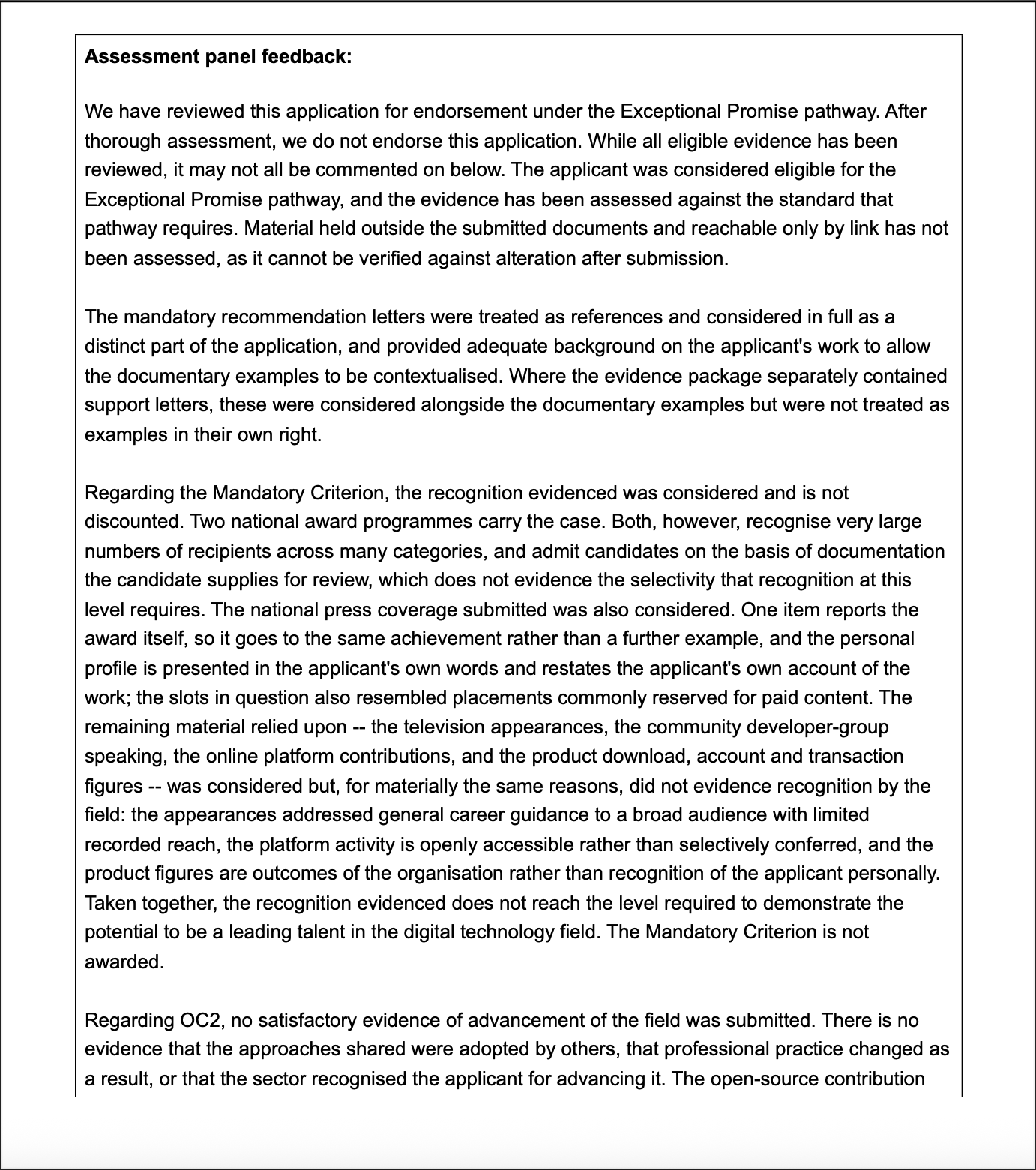
First, I want to thank you all for your time, your effort and your contributions to my Global Talent journey. Thank you. Unfortunately, I was NOT endorsed. Yeah, it breaks my heart, and it took me a long time to decide to post this here, but I feel I owe you all the outcome of my application.
While I understand the assessor didn’t feel my application was compelling enough, I found some errors that are very hard to ignore, so I’ve decided to appeal. I’m going in with 50/50 hopes: either I get the endorsement, or at the very least I come away with more insight into how to approach my next application, or maybe I just give up on the GTV altogether, because their assessment now feels like it applies stricter rules that fall well outside their own guidelines on what actually qualifies as evidence.
Below are the errors and unfair judgements I noticed, followed by a draft of the appeal I’m preparing. My hopes are low, but I genuinely believe my MC, OC2 and OC3 were convincing and simply weren’t credited.
Unfair judgement Noticed:
Mandatory Criterion
- Called the awards non-selective, though each category has one winner and I won mine.
- Treated independent judging as self-certification just because documentation was supplied.
- Ignored the Credence letter’s explicit recognition of my leadership.
- Called the press “own account” and “paid content” with no basis; it is independent journalism.
- Conflated the award report and the separate ThisDay feature as one item.
- Dismissed national TV invitations as “career guidance” with “limited reach.”
- Used “openly accessible” as a reason, though it matches no MC evidence.
- Reduced EV1 to organisation figures and ignored my personal product leadership.
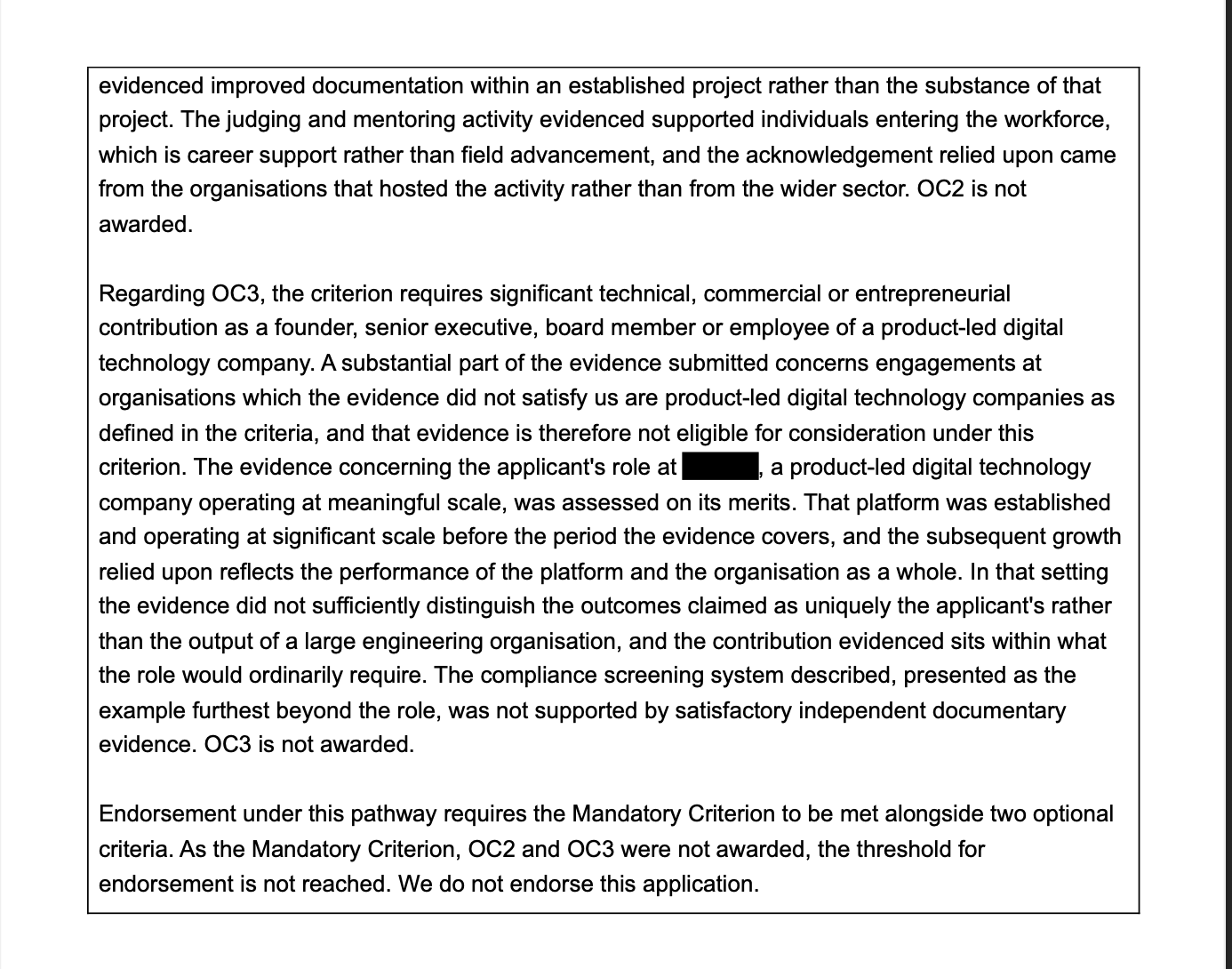
Optional Criterion 2
- Applied the wrong standard: demanded proof of adoption, not just contribution.
- Relabelled judging and guiding as “career support,” against Tech Nation’s own examples.
- Called the recognition host-internal, ignoring independent selection and a 1,000+ event.
- Did not credit the speaking, though selected, named, and 150+ attendees.
- Understated the Apache Kafka contribution, though merged into a core part by its governing committee.
Optional Criterion 3
- Refused partly over the AML system, which was never submitted under OC3.
- Applied OC2’s “beyond your role” standard to OC3.
- Assessed a pre-existing platform, not the newly built Nomba Card.
- Ignored the individual attribution (named diagrams, my pull requests, my commits).
- Excluded Africa Prudential and Airtel as not product-led on an unstated definition.
- Relied on organisation-wide growth I never advanced under OC3.
Appeal Drafts
Global Talent: Endorsement Review
Reasons for review (Tech Nation, Digital Technology). Applicant: [Applicant]
Mandatory Criterion (2.1)
The Mandatory Criterion requires that I have been “recognised as having the potential to be a leading talent in the digital technology field in the last 5 years.” My evidence meets this on two fronts: I have already led the design and delivery of digital products at scale, and independent others, being expert award panels, national media, and external organisations that adopted my work, have recognised that leadership. I address each reason for refusal in turn.
-
On “very large numbers of recipients across many categories”: each category has a single winner. My [National Award A] category has only one winner, and I was that winner (EV4); the [National Award B] winners’ page shows separate categories each with its own winner, and I won mine (EV3). Many categories, each with one winner, is selectivity within each category, not mass recognition.
-
On “admit candidates on the documentation the candidate supplies” and “does not evidence selectivity”: both awards are conferred by others through independent judgement against leadership and impact criteria. The [National Award A] use a three-round process assessed by an independent Judging Panel and Advisory Board (EV4). The [National Award B] involve nomination by industry professionals, independent expert judges, a documentation review, a structured interview, and a weighted scoring rubric covering Impact, Innovation and Leadership, all of which I submitted (EV3). Submitting documentation for independent review does not indicate a lack of selectivity; rigorous selection works precisely by independently assessing the evidence a candidate provides, which is what happened here. Recognition chosen by an independent judging panel from among nominees is selectively conferred in the very sense the decision treats as the required standard elsewhere, and these awards satisfy it. The [National Award B] panel’s own letter confirms the point, describing me as one of [country]'s leading professionals, recognising my deep technical leadership, and calling me a product leader (EV3). Independent expert bodies selecting me against leadership criteria and describing me in those terms is recognition of the potential to be a leading talent.
-
On “one item reports the award itself, so it goes to the same achievement”: this applies only to the [national newspaper 1] report of the award. My [national newspaper 2] feature is a separate item on the impact of the systems I built (EV5), so it is a further, independent example, not the same achievement.
-
On “restates the applicant’s own account” and “paid content”: the [national newspaper 1] coverage is an independent journalist’s report about me, not my own account. It was written by the named journalist [named journalist], published in the [national newspaper 1] (in print since 1949), and appears in the publication’s news section under its own byline and publication date, with no sponsored, advertorial or paid-content label (EV3). The [national newspaper 2] feature, in a national newspaper with over 1.3 million monthly visits, likewise reports on the impact of the systems I built (EV5). The Mandatory Criterion looks to recognition by others, and independent journalists choosing to report on me and my work is, in itself, that recognition; the relevant question is whether the coverage is independent, which it is, not the particular form the content takes. The decision engaged the content of the coverage rather than the fact that independent media recognised me, and neither the articles themselves nor anything else in the evidence provides any basis for treating them as paid placements.
-
On “general career guidance with limited recorded reach”: the decision overlooks the recognition these invitations represent. I was invited twice, by different presenters, by [state broadcaster], the [state broadcaster] broadcaster with national distribution across [national TV platforms], on the stated basis of my contributions to the industry (EV5). In the first appearance I spoke on youth in technology and addressed what the state and government should do to develop the sector and bring more young people into it; being invited onto a state broadcaster to speak to the state’s own approach to youth in technology is recognition of my standing in the field, not merely the delivery of career guidance. The second appearance, on a career in software engineering, was a further invitation on the same basis. As with the press, the recognition lies in a national broadcaster independently selecting me to feature, on the strength of my contributions, and the content of the segment does not negate that an independent broadcaster recognised me. The description of the reach as limited also does not fit a nationally distributed broadcaster.
-
On “openly accessible rather than selectively conferred”: this reason does not correspond to any of my Mandatory Criterion evidence. My Mandatory Criterion evidence is the two awards (EV3, EV4), the independent media coverage (EV5), and the product-led leadership corroborated by external organisations (EV1, EV2); none of it is “openly accessible platform activity.” The phrase can only refer to online platform contributions, being my Stack Overflow and open-source activity, which I submitted under Optional Criterion 2 and mentioned in my personal statement, which is context and not evidence. The only platform reference within my Mandatory Criterion evidence is my commit history in EV1, which concerns private repositories and is not openly accessible. The decision does not identify which activity it means, and it treats material that was not part of my Mandatory Criterion case as a reason to refuse that criterion. My Mandatory Criterion evidence should be assessed on its own terms, and on those terms it meets the criterion. In any event, where these items are relied on at all, the recognition was selectively conferred, not openly accessible: my [Open-Source Project] pull request was reviewed and merged into the project’s codebase by a member of its governing committee, and my [developer conference] and [developer community] talks were given by selection and by written invitation. Only open participation, such as posting on Stack Overflow, is openly accessible, and that is not the recognition I rely on.
-
On “the product figures are outcomes of the organisation rather than recognition of the applicant personally”: EV1 was submitted to show what I personally did, as a backend engineer, to drive [Employer]'s growth. Leading the growth of a product-led company, product or team is expressly one of the evidence types Tech Nation’s guidance accepts for this criterion, and EV1 provides exactly that. It sets out the products I built and architected at [Employer], being the Personal Banking platform, the revamped Business Banking platform, multi-account support and [QR product], with architecture diagrams that bear my name and over 4,000 commits under my account. The growth relied on in the decision followed directly from these products I engineered, and it is corroborated by [Employer]'s CEO, who attributes that growth to me personally, and by [Partner Company 1]'s [senior manager], who confirms I led the development of the product [Partner Company 1] adopted and continues to use (EV2), with national news coverage of my work as further support (EV5). This is a personal contribution recognised by others, not anonymous organisational output.
Taken together, the MC requires that I have been recognised as having the potential to be a leading talent. On the evidence I submitted, being two independently judged national awards, independent national media coverage, and product-led leadership corroborated by [Employer]'s CEO and by external organisations that adopted my work, that requirement is met. I respectfully request that the MC be reconsidered and awarded.
Optional Criterion 2 (2.2)
OC2 requires “recognition for work beyond the applicant’s occupation that contributes to the advancement of the field.” My evidence meets both parts: independent bodies recognised me for work outside my paid role, an independent conference that selected me to speak, sector organisations that invited me to judge and guide emerging talent, and the [Open-Source Project] project that merged my contribution; and that work advances the field by transferring technical knowledge to other engineers and raising the standard of those entering it. I address each reason for refusal in turn.
-
With respect, the panel assessed OC2 against a standard the criterion does not set. It refused the criterion because it found “no evidence that the approaches shared were adopted by others, that professional practice changed as a result.” OC2 asks whether the work “contributes to the advancement of the field.” Tech Nation’s guidance describes qualifying activity as going beyond your day-to-day profession to engage in a significant activity that contributes to the advancement of the sector, with examples such as mentoring, advising and teaching, none of which require proof that others later adopted the work. Requiring adoption, or a measurable change in practice, therefore imports a standard neither the criterion nor the guidance contains, and OC2 is met by the contribution itself.
-
On the correct standard, my conference speaking contributes to the advancement of the field. My [developer conference] session, “Building Distributed Systems with gRPC,” was, in the evidence’s own record, “reviewed and accepted by the [conference speaker team], who prioritise experience-based technical talks over promotional content” (OC2 EV2), so it was substantive technical knowledge, not promotion. In it I set out how gRPC delivers lower latency and higher performance than REST, with real-world examples, and EV2 records that when I asked the room, “almost none had” built systems with gRPC, so the approach was new to most present. As the evidence puts it, I “contributed to promoting a higher-performance approach to building distributed systems beyond my own organisation.” Transferring a better engineering approach to practitioners who did not use it is knowledge transfer that raises the capability of the wider sector, which is a contribution to the advancement of the field.
-
The same evidence meets the other elements of OC2, recognition and work beyond my occupation. My session was “reviewed and accepted by the [conference speaker team],” I was “featured as a named speaker on the official [developer conference] website, with my headshot, name, and session title,” and the event “drew over 150 attendees” (OC2 EV2). That is recognition conferred by an organisation independent of my employer. EV2 also records that I “delivered the session voluntarily and in a personal capacity, and it was not sponsored by my employer,” which is exactly the voluntary, non-employer basis the guidance requires, and plainly work beyond my paid role as a backend engineer.
-
The panel discounted my [Open-Source Project] contribution as “improved documentation within an established project rather than the substance of that project” (OC2 EV2). In the evidence, [Open-Source Project] is “the de facto standard for data streaming across industries,” “used by over 100,000 organizations worldwide, including more than 80% of Fortune 100 companies.” My contribution was to “a core part of [Open-Source Project]'s internal system responsible for handling message positions (offsets),” setting out when an offset is invalid and what inputs and errors to expect, and it was “reviewed and merged by a member of the [Open-Source Project] Project Management Committee, the group that governs the project,” who thanked me. Shaping how the global community of engineers who build on [Open-Source Project] understands and correctly uses a core part of that platform is contribution to the field itself, not to any one employer, and I made it on my own initiative, outside my paid role.
-
The panel treated my judging and guiding of emerging talent as “career support rather than field advancement” (OC2 EV1). Tech Nation’s own OC2 guidance names advising, teaching and mentoring among the examples of qualifying activity, asking only that it be voluntary and not undertaken while representing an employer, which is what my evidence shows. At [Training Organisation], which trains engineers to a professional, industry standard before they enter [country]'s technology sector, my role went beyond scoring: across three separate cohorts I assessed over 50 participants, but as EV1 records, I “showed them where it met professional standards and where it fell short,” gave “practical advice on building software that is more secure and reliable,” and combined assessment with “technical feedback and industry-standard guidance.” I also ran a dedicated session on professional engineering standards whose content spread within the cohort beyond those I scored. That is teaching and passing on knowledge, not scoring alone. The guiding is documented, not asserted: [Training Organisation] invited me onto its Mentorship Board, and EV1 includes message exchanges from several participants who sought my guidance, including one where I gave ongoing technical guidance to a participant on the project they were building. At [Conference Organiser], likewise, I did not only judge; I advised the winning team on how to build their product, including the mobile app, with the meeting note recording my involvement in the design process. This voluntary teaching, advising and guiding of others, carried out independently of my employer, is exactly the kind of activity Tech Nation’s examples describe, so treating it as career support departs from the guidance’s own examples of what qualifies. As for recognition, the evidence shows I was invited “on the strength of my professional standing rather than any employer affiliation,” chosen repeatedly across three cohorts, and selected to judge at [Conference Organiser] before a wider-sector audience of over 1,000 including the state’s [senior government official]. That is recognition by independent bodies in the sector, not a host acknowledging its own participant, and I did all of it beyond my paid role, which is what OC2 requires.
Taken together, OC2 EV1 and OC2 EV2 show recognition, from an independent conference, from sector organisations that selected me to judge and guide emerging talent, and from the open developer community, for work I carry out beyond my employed role, and that work contributes to the advancement of digital technology. I respectfully ask that OC2 be reconsidered and awarded.
Optional Criterion 3 (2.3)
OC3 credits a significant technical, commercial or entrepreneurial contribution as a founder or employee of a product-led digital technology company. Only one of technical, commercial or entrepreneurial is required; the only company requirement is that it be product-led; and the only requirement on the contribution is that it be significant. I address each reason given for refusing OC3 in turn.
-
On the finding that my evidence concerned organisations that are not product-led digital technology companies. The decision did not state the definition it applied. [Company A] builds and scales digital products: its flagship product [Flagship Product] processes billions of naira for institutions including [Institution 1] and [Institution 2], and its consumer-facing product [Consumer Product] (previously under a different name), with over 10,000 downloads, is built on [Flagship Product], which I contributed to building and integrating. My contribution there is individually attributed by over 1,320 commits and 72,100 changes under my account, the Bond and Equity module architecture I designed, pull requests I authored and merged, and a reference letter from the [senior manager] (EV1, EV2). [Company B’s digital lab] is the division that builds and scales [Company B]'s customer-facing digital products; within it I led the reengineering of [broadband product], a consumer-facing broadband product serving hundreds of thousands of [Company B] customers and live at [product URL], evidenced by architecture diagrams bearing my name and the live production deployment (EV3). Both are product-led on any reasonable definition, and excluding this evidence on an unstated definition is not applying the criterion correctly.
-
On the finding that the platform “was established and operating at significant scale before the period the evidence covers,” with growth reflecting the organisation as a whole. This finding was directed at [Employer], and it does not fit the [Employer] evidence I submitted under OC3, which is the [Card product], a product the company had not previously offered, built in January 2025 and live with customers in February 2025, with no pre-existing platform behind it. I did not present [Employer]'s platform-wide growth figures under OC3; those sit in my Mandatory Criterion evidence. Where my OC3 evidence does refer to revenue, in the [Company A] reference letter, it is expressly attributed to my own contribution, not to organisation-wide performance.
-
On the finding that the evidence did not distinguish the outcomes as uniquely mine rather than the output of a large engineering organisation. This finding was made specifically about [Employer], and it does not fit the product I submitted. I led the development of the [Card product] and built its backend (EV2). This was not the output of a large engineering organisation. The backend is attributed to me individually and by name: the architectural diagrams for the debit-authorisation and ATM-withdrawal flows are authored under my name and dated; the pull requests are merged under my own account; the code commits are mine; and the live [Card product] and its customer transactions run on the backend I built (EV2). Records of this kind, each naming one individual, are by their nature distinguishable from collective output: if these outcomes were the undifferentiated work of a large organisation, there would be no single-author diagrams, no pull requests under one account, and no individual commit trail identifying me. The evidence therefore does distinguish my contribution as uniquely mine, and the decision did not engage with it.
-
On the finding that the contribution “sits within what the role would ordinarily require.” OC3 credits contribution made “as an employee,” and “significant” refers to the impact of the work, not to whether it went beyond my role. The “beyond your occupation” requirement belongs to OC2. Applying it to OC3 added a requirement the criterion does not contain.
-
On the finding that the compliance screening system “was not supported by satisfactory independent documentary evidence.” I did not submit that system under OC3. My OC3 evidence was [Flagship Product], the [Card product] and [Company B] [broadband product]. The compliance system appears only in my personal statement and in a recommendation letter, where my recommender cited it as an example. The decision took that example from the recommendation letter and refused the criterion on the sufficiency of a document I never put forward under OC3, while leaving the evidence I did submit unaddressed. In any event, that system was described by an independent senior authority, [Employer]'s [senior executive], so it was not unsupported.
Taken together, OC3 requires a significant technical or commercial contribution as an employee of a product-led digital technology company. On the evidence I submitted, the [Card product], [Flagship Product] and [Company B] [broadband product], that requirement is met on both the technical and commercial limbs, at companies that are product-led on any reasonable definition. I respectfully request that OC3 be reconsidered and awarded.