Request for Review: Promise

Request for Review: Promise — Backend/Payments Engineer (fintech), 4 IEEE conference papers, no OSS/talks yet

Hi all — long-time reader, first post. I’m planning a Stage 1 application in the next 2 months and would really appreciate a sanity check on route choice and evidence mapping before I spend the £524 and lock in three reference letters.


Profile in brief

  • Based: US (San Francisco Bay Area), not currently in the UK.

  • Field: Backend / distributed systems, card payments and ledger infrastructure.

  • Education: M.S. Computer Science (TOP US university, Dec 2021).

  • Current role: Software Engineer III at a large publicly listed US fintech (product-led, consumer banking/cards app, tens of millions of users). Mar 2025 – present.

  • Previous role: Software Engineer in the payments division of a large publicly listed global bank. Jan 2022 – Mar 2025 (plus a 4-month paid internship there in 2021).

  • First role: Software Engineer I at a small private company (data/crawling infrastructure), Feb 2019 – Jan 2020, ~1 year.

  • Publications: 4 peer-reviewed conference papers, all 2024, all IEEE- or equivalent-indexed conferences (not journals):

  • Compensation: base + equity substantially above the UK median for an equivalent senior backend role (I can evidence with offer letters, payslips and a written comparison against ONS/levels.fyi UK benchmarks).

Headline work (what I’d actually build evidence around)

  1. In-house card processing platform — co-designed and built the system. Tier-0 service, 99.9% annual uptime. Caveat: this was a whole-team effort — I own specific components, not the whole thing.

  2. Real-time service feature I built this year — I led a 3-engineer team to design and build this end-to-end, ~$6.6M annual saving, which I can evidence with an internal impact memo and a letter from a non-referee coworker.

these were contribution at my current company from 2025 to present


Proposed evidence mapping

Mandatory Criteria (recognised as a leading talent / potential leading talent):

  • Impact memo + architecture/ownership artefacts for the real-time service ($6.6M annual saving, 3-engineer team lead), with a supporting letter from a senior engineer/manger in the company who is not one of my three referees.

  • High remuneration evidence (contracts + earnings history + written UK-median comparison), paired with the above so it isn’t salary in isolation — the guidance is explicit that salary alone is insufficient.

Optional Criteria 3 (significant technical contribution at a product-led digital technology company) — my strongest:

  • I want to use the work experience here, but how do I differentiate it from the Mandatory Criteria? if they carry the same work?

Optional Criteria 4 (academic contributions through research):

  • 4 IEEE papers with citation and google scholar profiles

Reference letters – are they good enough?

I can currently get:

  1. A VP at my current employer (the large public fintech) — has known my work ~1.5 years, senior enough to count as an established expert, but is inside my own reporting chain.

  2. A lead software engineer at my previous employer (the large public bank) — has known my work ~3 years, was a peer/tech lead rather than my manager.

  3. A lecturer at a non-UK university, a recognised computer vision expert — known me ~2 years.

My worries:

  • The guidance says evidence of recognition from “an immediate colleague, manager, or friend” isn’t sufficient. Does a VP two or three levels up in my own chain fall foul of that, or is that aimed at direct line managers?

  • Is “lead software engineer” senior enough to read as an “established expert in the digital technology field”? The company is very large and it’s very difficult to reach out the high level executive

  • Does a non-UK academic in computer vision carry weight when my actual application is about payments infrastructure?

  • Two of three letters would be internal to companies I’ve worked at. Is that a red flag, or normal for IC applicants?
Your profile has a sensible structure, but I would be careful about using the same current-company achievement for both MC and OC3. The distinction should be very clear: MC should establish recognition as a leading/potential leader, while OC3 should demonstrate your significant technical contribution and measurable impact. The current $6.6M saving and leadership of a 3-engineer team could potentially support both narratives, but you should avoid simply repeating the same evidence. The current rules require at least two pieces of evidence for two qualifying criteria, with each evidence piece used only once.

For OC4, the four peer-reviewed papers are relevant, but citation evidence will be much stronger if you can show independent academic recognition, citations, adoption, or other measurable research impact rather than publication alone. Since the papers are all recent, low citation counts would not necessarily be surprising, so I would look at the overall research impact rather than using citations as the only measure.

On the recommendation letters, a VP who is several levels above you can be a good referee if they genuinely know your work for 12+ months and can speak specifically about your achievements. The key issue is not simply whether they are in your reporting chain; they need to be an established expert and provide detailed knowledge of your work.

A Lead Software Engineer can potentially qualify, but the question is whether you can demonstrate that they are an established expert in digital technology. Their title alone is not enough, so their experience, seniority, technical achievements and industry standing should be clear through their credentials.

The non-UK computer vision academic can still be a useful referee even though your specialism is payments/distributed systems, provided they genuinely understand your technical work and can credibly assess your potential as a digital technology leader. However, I would prefer the three referees collectively to give strong coverage of your actual field.

Having two referees from previous/current employers is not automatically a red flag. What matters is the quality and independence of their assessment. Ideally, your letters should provide different examples and perspectives rather than looking like employer confirmations of your job duties. The current GOV.UK guidance specifically requires the three letters to contain different examples of your achievements, skills, experience and contribution.

One final point: I would not make the high salary comparison a major MC argument. GOV.UK says salary level can be considered as a factor, but the qualifying evidence still needs to establish recognition, leadership potential and the relevant achievements.

So, I would suggest you strengthen your application focusing on stronger independent recognition for MC, very clearly differentiated OC3 evidence, and ensure that all three referees can clearly establish their expertise and provide detailed, first-hand evidence of your work. If a stronger referee closer to your actual technical specialism is available, I would prioritise that over choosing someone simply because they hold a higher corporate title.

Hi @hsong427

You are approaching this strategically by planning ahead and having a sanity check on your pathway and how your evidence aligns correctly. From experience, Tech Nation does not reference an applicant’s previous application when deciding a current one, so it’s not strategic to submit an application just as a trial. It’s cheaper to learn from others.

Going by the guidance, you are eligible as a Software Engineer working in a banking/cards processing company (technical applicant working in a technical company). However, while Neo banks are tech companies, they are usually not product‑led. This does not affect your eligibility, but some criteria like OC3 require contribution in a product‑led company. You won’t be penalised outright, but these are the simple checks that help your evidence align correctly and increase its chances of being strong.

You also have more than 5 years of experience from your first role as a software engineer in 2019. I believe most people don’t begin first roles as experts, so if this were an intern role, it would reduce one year, and if you had any gap you can clearly state it. You may still end up being within the 5‑year timeframe and can be rightly positioned for promise.

On your evidence, the MC impact memo + architecture/ownership artefacts show what you have done. However, MC is about how you led the product, team, or company direction. So you want to show how you led the development team to build the product. High salary can support but it’s not sufficient. Overall, your application still needs to show that you have advanced and impacted the sector outside your paid job.

For OC3, what you stated under MC can work well for contribution, but you need to clearly show the evidence and how it has impacted the sector through a product‑led company. Also, if you show leadership direction in MC and state it again as contribution here, it will weaken the application because evidence needs to be unique, unless you are presenting different evidence to establish what you did in each criterion.

For OC4, four IEEE‑published papers with citations can be okay. But the citations should be substantial, since you don’t have other metrics showing how the papers advance the sector through your research. Also, you need at least two unique pieces of evidence in each criterion. You currently have only one here.

On your LORs, a VP is an executive and is okay, and the lead software engineer is also fine since the person does not currently work with you. If the person is an established expert, they won’t be seen as a mere work colleague. For the lecturer, you will need to check the person’s profile to be sure they are established in the tech sector too, as academics are not necessarily experts in the sector.

Overall, you have some bits. However, you need to give some time to work across all the chosen criteria, get externally validated evidence to increase your chances.

All the best.

MC’s main gap is that all the evidence is employer-sourced. The Guide is explicit that salary on its own isn’t enough and that letters from immediate colleagues don’t count as independent recognition. You need at least one piece an assessor can verify outside the company.

Using the same role for both MC and OC3 is workable if MC focuses on how you directed the team and product decisions while OC3 covers the measurable downstream impact. Both drawing from the same internal evidence base compounds the self-documentation risk. Your IEEE papers under OC4 need at least two pieces of evidence in that criterion, and conference papers without meaningful citations or evidence of adoption are thin on their own.

A VP several levels up works as a referee if they have direct, specific knowledge of your work and can speak to achievements beyond a generic employment confirmation. With two internal referees and all-internal MC evidence, the application leans heavily on employer validation.

Thanks @Noddy, @Raphael and @Akash_Joshi — genuinely useful, and the point you all converged on independently (that my MC is entirely employer-sourced) landed.

Before I respond on evidence, two things I should have put in the original post, because I think they change the picture:

1. I already hold IEEE conference technical committee roles. Over the past few years I’ve sat on the technical programme committees of several IEEE conferences, reviewing submitted papers and making accept/reject recommendations. Re-reading MC, it maps directly onto “You have held or hold a significant expert role participating on panels, or individually, assessing the work of others in the same field or a field of specialisation related to the digital technology sector.” It’s outside my employer, it’s spread over several years rather than assembled for this application, and it’s independently verifiable.

2. My Google Scholar citation count is ~120, not the near-zero everyone reasonably assumed for papers published in 2024.

So the “no independent recognition” problem is narrower than my original post implied — though I accept it’s still where the application is thinnest.

I’m going for Exceptional Promise. Here’s where the evidence stands after your feedback.


MC — revised plan

Piece 1: the IEEE technical committee work.

Piece 2: leading a 3-engineer team that designed and built an in-house real-time merchant-decisioning service. This took a function that the card network had been performing on our behalf and brought it inside our own auth pipeline — our platform went from handling none of that decisioning to handling 100% of it, and the ~$6.6M/yr we had been paying the network for it stays with us. Shipped in 3 months.

Salary/comp evidence I’m now treating as supporting context only, not a pillar, per the feedback above.

Q1. For the committee role, what evidence actually satisfies an assessor? I have confirmation emails, plus screenshots and logs from the review systems showing assigned papers and completed reviews. Some of these conferences also list committee members publicly on their websites. Is the public listing the thing that carries weight, or are the emails and system records sufficient on their own? And does reviewing for academic conferences read as “the digital technology sector” to Tech Nation, or is it treated as purely academic and therefore OC4 territory?

Q2. My plan was to support this with a letter from a manager-level person with ~20 years in the industry. He is not my direct manager and has never been in my reporting chain — he sits in a different org within the same company, and saw my contribution through the integration between our teams.

Re-reading the note at the foot of MC — “Evidence of recognition, such as Reference Letters, provided by an immediate colleague, manager, or friend are not sufficient” — I can’t tell whether that rules him out. Does “immediate colleague” mean anyone inside the same company, or literally someone on your own team or in your reporting line? If it’s the narrow reading, a senior person in a separate org with two decades of experience seems like exactly the kind of independent-but-informed assessor the criterion wants. If it’s the broad reading, I’m stuck: I have no route to a director-or-above contact at the network or partner company on the other side of the integration, so an external letter isn’t available to me here.

So the question I actually need answered: if the only senior people who have genuinely seen my work are inside my own company, what carries an in-house project for MC instead? The guidance says letters alone are insufficient regardless, so I assume the letter was never going to do the heavy lifting — what non-letter evidence have people used successfully for work that by its nature happened inside a company?


OC3 — different project, same employer

Same employer, separate project: I was a core engineer on the in-house card processing platform that replaced a third-party processor, migrating 100% of transaction traffic onto our own system at ~500 TPS. No overlap of documents with MC — MC covers what I directed, OC3 covers measurable impact.

On the product-led question @Raphael raised: my employer isn’t a bank. It’s a consumer product company — mobile app, tens of millions of users, in-house platform engineering — that partners with chartered banks. I’ll frame it that way rather than as a neobank.

Q3. My employer’s public quarterly earnings materials reference the platform my team built. Combined with an employer letter placing me on the core team, does a public earnings document do useful work here, or is it too company-level to say anything about me personally?

Q4. On “architecture diagram clearly showing your contribution… demonstrates your personal work, not that of the company or team of individuals”how have people actually solved this in practice?

The obvious proof would be commit and PR history, but I can’t produce it: the repos are private and the GitHub account is under my employer’s org, so nothing is public and I can’t export it freely. That leaves the architecture documentation plus a letter from a senior co-worker (a different person from my three referees) confirming which components I personally owned.

I take it the “immediate colleague” restriction doesn’t bite here, since OC3 expressly lists “Letter from an employer wherever applicable… should be written by another individual” as acceptable evidence — please correct me if that’s wrong. My real worry is different: without any public code, is an annotated architecture document plus an employer letter enough to isolate my personal contribution from the team’s? Has anyone got a private-repo situation past an assessor, and if so what did the evidence look like — redacted commit logs, internal design docs with author attribution on them, something else? I’d also need employer clearance for anything I do submit, so I’d rather know which formats are worth asking for.


OC4

Piece 1: four peer-reviewed conference papers plus the Google Scholar citation record (~120).

Piece 2: an expert letter, per “A letter of support from a research supervisor or other expert in your area of expertise affirming their potential world-class standard.”

Q6. I have two candidates for that letter and I can’t tell which reads better:

  • (a) A PhD holder who is a genuine domain expert in my research area, working at a technology company but without a senior title.

  • (b) A managing partner at a startup that has adopted my published work in their product.

(b) brings independent adoption, which feels like the stronger signal, but they’re a business figure rather than a subject expert. (a) is the closer fit to “expert in your area of expertise” but has no title to point at. Is the right move to have (a) write the letter and present the adoption by (b) as separate evidence in its own right?

Thanks again — this thread has already saved me from at least two mistakes.

IEEE technical committee work is a much stronger Mandatory Criteria fit than anything in the original evidence. The mandatory criteria explicitly cover holding a significant expert role assessing the work of others in the same field, and reviewing papers in payments and distributed systems sits inside that language directly rather than reading as purely academic. The committee listings and review system logs corroborate the same role from two independent angles, so submit both.

That immediate colleague exclusion is about the relationship, not the org chart. A senior person in a different reporting line who observed your work through the integration isn’t your immediate colleague or manager, so the letter should stand on its own merits. It still can’t carry Mandatory Criteria weight by itself, since reference letters never substitute for additional evidence, so it needs to sit alongside the committee records rather than replace them.

On the product‑led point you raised, your earlier description aligned more closely with a neobank, and the updated phrasing “consumer product company- mobile app, tens of millions of users, in‑house platform engineering, that partners with chartered banks” - still doesn’t clearly reflect a product‑led model. Product‑led refers primarily to how a company sells and distributes its product, usually digital, rather than the company’s operational structure or category.

Regarding the IEEE technical committee, were you invited directly through an official IEEE letter or email, or was there a competitive selection process where you were chosen among other professionals? You’ll also need to demonstrate what you contributed that advanced the sector. Based on your questions and what you’ve described so far, this fits more strongly under peer review, where you evaluate the work of others within your area of specialisation. So, show the letter or email, the journals that were assigned to you to review and the confirmation that your review was accepted and if possible the link of the publications(They are not mandated to visit but still give some kind of external validation)

All the best.

Thanks @Akash_Joshi Submitting the public listings and the review-system records together as two corroborating angles makes sense, and I’ll build MC around that.

One correction to something you assumed, because I’d rather you assess it on the real facts:

The committees aren’t payments-specific. They’re computer science industry conferences hosted by IEEE spanning multiple tracks — AI, computer vision, etc and adjacent areas — rather than venues focused on payments or distributed systems. My own reviewing sits across all Computer Science tracks. So the papers I assess are squarely digital technology, but they aren’t the same subfield as my day job in card payments and ledger infrastructure.

That leaves me reading MC’s “assessing the work of others in the same field or a field of specialisation related to the digital technology sector” as still satisfied on the second half of the phrase rather than the first. Does that hold up in front of an assessor, or does a mismatch between the field I review in (CS) and the field my application is about (payments infrastructure) weaken it? I’d rather over-explain the connection in the evidence than have someone reading the file conclude the reviewing is a separate hobby.


Second question, on the other half of my MC.

MC bullet 1 reads: “You led the growth of a product-led digital technology company, product or team inside a digital technology company, as evidenced by reference letter(s) from leading industry expert(s) describing your work, or as evidenced by news clippings, lines of code from public repos or similar evidence.”

The work I’d point at: I led a 3-engineer team that designed and built an in-house real-time merchant-decisioning service. It took a function the card network had been performing on our behalf and brought it inside our own auth pipeline — the platform went from handling none of that decisioning to 100% of it, and the ~$6.6M/yr we were paying the network for it stays with us. Shipped in 3 months.

Is leading a project like that valid MC evidence at all, or is it structurally the wrong kind of thing for MC? Two specific doubts:

  1. Does “growth” cover this? It’s growth in the sense that the product now owns a capability and a volume of traffic it didn’t before, and captures a fee that used to leave the company — but it isn’t new users or new external revenue. If assessors read “growth” as users and top-line revenue only, this argument dies and I should stop building it.

  2. Even if it qualifies, can it be evidenced? The bullet’s own examples are reference letters from leading industry experts, news clippings, or public repo code. I have none of those for this project: it’s internal, unannounced, the repos are private under my employer’s org, and the only people who saw it are inside the company. What I can produce is an architecture diagram/design and a letter from a manager-level person with ~20 years’ experience who was outside my reporting chain. You’ve already said that letter stands on its own merits but can’t carry MC alone — so is the honest answer that this project simply can’t be MC evidence for lack of external attestation?

If so I’d rather hear it now. I’m fine with MC resting entirely on the committee work if that’s the stronger and cleaner argument.

The field mismatch in the panel work isn’t a real problem. The Mandatory Criteria language covers assessing work in the same field or a field of specialisation related to the digital technology sector, and reviewing across AI and computer vision tracks sits inside that second half regardless of the gap with payments infrastructure. Submit it as is, and the public listings plus the review-system logs are the right pairing since they corroborate the role from two separate angles.

Growth in that criterion isn’t limited to new users or revenue. Delivering a major product capability that changes what the platform owns counts too, so the merchant-decisioning work is conceptually the right shape for it. The problem sits in the evidence types the criterion lists alongside that bullet: reference letters, news clippings, lines of code from public repos. All three are externally checkable, and an internal architecture document plus one internal letter doesn’t clear that bar even when the letter itself is strong.

With the repos private and the project never announced outside the company, there’s no route to independent verification for this specific piece, so it can’t function as MC evidence regardless of how the leadership angle is framed. Building MC on the committee work alone is the cleaner call, and it’s already the stronger of the two.

Thanks @Akash_Joshi — that settles it. MC will rest on the committee work alone. I’m dropping the work experience
Three follow-ups, two on MC and one on OC3.


1. Does this actually count as two documents, or one recognition documented twice?

The guidance says “At least 2 unique documents showing you are recognised as either a leading talent or potential talent.” My plan was:

  • Doc 1: review-system screenshots and logs — assigned papers, submitted reviews, accept/reject recommendations — plus the invitation and confirmation emails

  • Doc 2: the conference websites listing me as a committee member

2. Timing. My committee appointments were once in 2023 and three times in 2026.

The guidance is explicit that “evidence made solely to support the timing of your application is unacceptable” and wants a consistent level of activity over time. My worry is the recent one looks assembled for this application. Should I wait until the end of this year to put more distance between the second appointment and the submission date?

3. OC3 — does it need externally verifiable evidence too?

The criterion is “significant technical, commercial or entrepreneurial contributions to the field as a founder or employee of a product-led digital technology company.”

Reading the OC3 evidence list, it seems to work differently from MC: it expressly names internal material — “documentation on product designs or architecture diagram clearly showing your contribution… no more than three A4 pages” — and “letter from an employer wherever applicable… written by another individual.” Nothing in there requires the work to have been announced publicly. Is that right, that OC3 is the criterion where internal evidence is legitimate, and the external-verification bar you described for MC doesn’t carry over?

If so, my OC3 plan is:

  • My employer’s public quarterly earnings materials, which reference the platform my team built

  • A reference letter from a senior colleague (not one of my three referees) placing me on that team and identifying the components I personally owned

Does that combination work, or does it fail on both halves?

@hsong427 I did ask you a question earlier, perhaps it was overlooked. To be clear, I don’t have any special interest in your application, and ordinarily I would leave it since my question wasn’t acknowledged. However, my commitment here is to the platform and to ensuring others don’t get misled from what is being posted, so I’ll still clarify this for everyone’s benefit.

IEEE committee work and IEEE peer review are not the same. You’re emphasising committee work but presenting peer‑reviewing evidence. Peer review aligns with MC because it involves assessing the work of others in your area of specialisation, provided your career trajectory shows you’re qualified to do so.

Being listed as an IEEE committee member on a conference website does not align with MC, it aligns with OC2(provided you have the evidence to back your claims). Committee members contribute to IEEE chapters, societies, conferences, student branches. They are different from peer review with different expectations.

Here’s a simple explanation of the difference between committee membership and peer review for clarity. You can as well check online. All the best.

Public conference listings and internal review-system records evidence different aspects of the same role. The listings establish the appointment and status; the system records show the actual review work performed. Each carries information the other doesn’t, so submitting both gives you two unique pieces rather than one recognition documented twice.

The 2023 appointment is the anchor Tech Nation looks for. Three more in 2026 on top of that reads as continued involvement across multiple years, which is exactly the sustained pattern the guidance wants. Waiting until year-end buys you little that the 2023 piece isn’t already doing.

OC3’s evidence list explicitly includes architecture documentation and employer letters, so internal material is legitimate there in a way it isn’t for MC. Your combination is structurally correct. The risk sits in the letter itself. A generic confirmation that you were on the team adds little, whereas a letter that names specific components you personally owned with measurable outcomes attached is what carries the criterion.

Public conference listings and internal review-system records evidence different aspects of the same role.

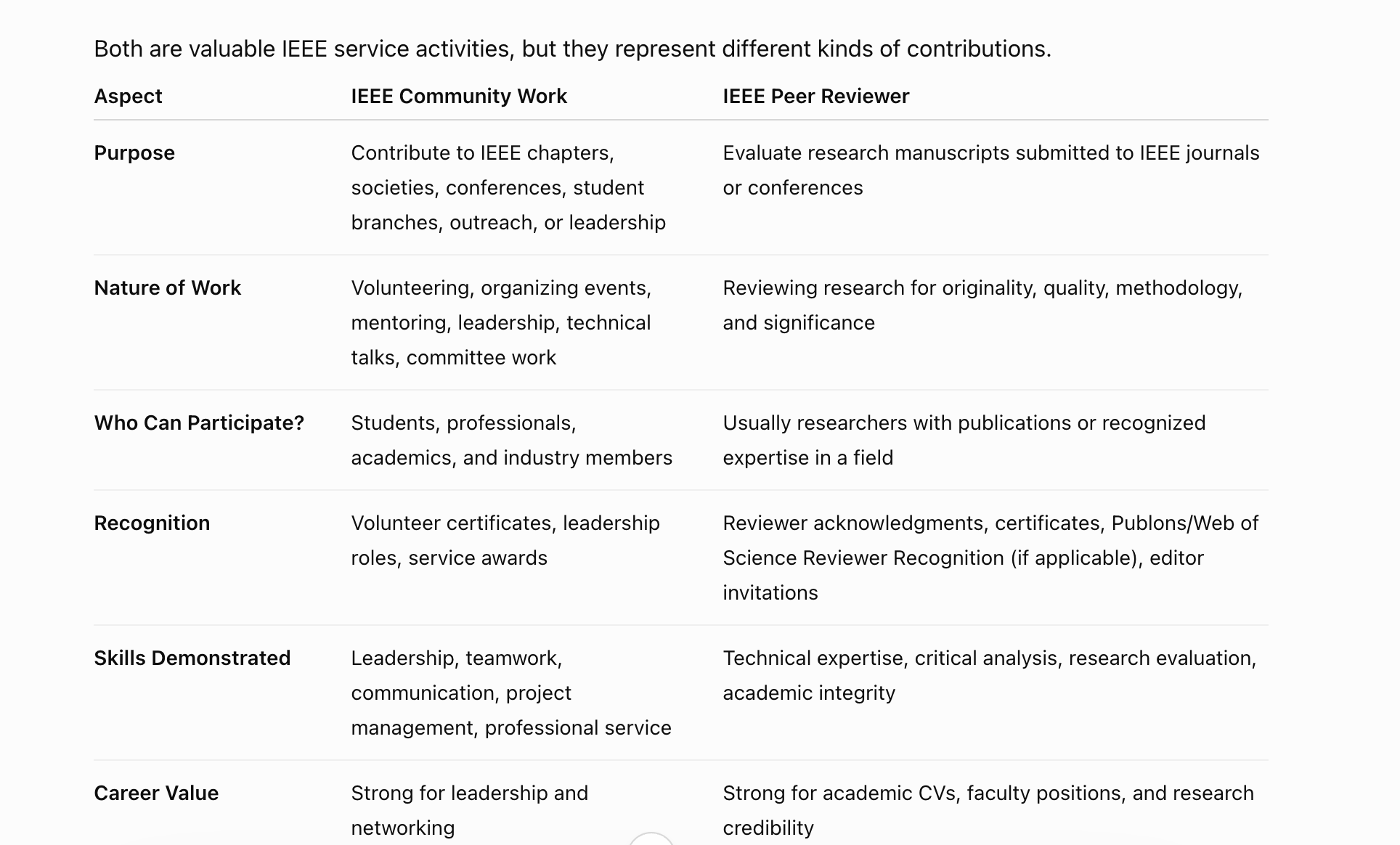
@Akash_Joshi I respectfully disagree. IEEE community work and IEEE peer reviewing are two distinct roles, and it’s not strategic to present them as the same. The concern I’m highlighting is that he refers to IEEE community work but provides evidence for IEEE peer reviewing instead. This could signal to an assessor that the applicant may not fully understand what he did and raise further questions.

Both are forms of service to IEEE, they are distinct:

IEEE Community Work = Volunteer, mentoring or helping with outreach and technical events.
IEEE Peer Reviewer = Scholarly review of research publications.

@Raphael — Thanks for raising this question. I overlooked earlier.

Let me answer it, and then correct a factual point about my case that I think is driving the disagreement — the fault for which is mine, because I described the role badly.

What the role actually is. I’m a member of the Technical Program Committee of specific conferences, administered through EDAS. A TPC member is appointed by the conference organisers to evaluate submitted papers: submissions are assigned to me in the system, I review them, and I make accept/reject recommendations that feed the programme decisions.

That is the entirety of the role. I hold no IEEE society, chapter or student-branch position, I do no outreach or event organising, and I have no volunteer service to point at. My appointment is to a particular conference’s programme committee, not to IEEE as a membership organisation.

So the “IEEE Community Work” column in your table — volunteering, organising events, mentoring, outreach — doesn’t describe anything I do. Everything I do sits in your second column: scholarly review of submitted research. On that we agree completely, and it’s why the evidence I have is review evidence.

@hsong427 Trust you’re doing well.

What you’ve described is peer reviewing, which aligns with MC rather than the committee work, which rightly aligns with OC2. I’d recommend ensuring that your description is consistent with the evidence you plan to submit. In this case your Doc1 and Doc2 should be one evidence set because they are unique and talk about the same activity.

All the best.

Thanks @Raphael — that’s clear, and I’ll take it. Doc 1 and Doc 2 collapse into one set because they describe the same activity. Understood.

One follow-up on that, because I think it may change the count.

These aren’t one appointment. They’re separate TPC appointments to separate conferences, made independently by different organising committees:

  • IEEE Conference A — Qatar, June 2026
  • IEEE Conference B — Portugal, September 2026

Different conferences, different chairs, different submission pools, different sets of papers assessed. Each appointment was conferred on its own; neither follows from the other.

Does that make them two distinct activities and therefore two documents, or does peer review read as a single activity stream to an assessor no matter how many separate venues appointed me?

@hsong427 That’s a great point, and the key question here is really 'what was done."

Even though the appointments were made by different committees and for separate conferences, the underlying activity is your peer‑review contribution - remains the same type of work. When presented together, they strengthen the evidence because they show sustained and continued involvement rather than a one off engagement.

So yes, they can be grouped under one evidence set (MC1 - Assessing the work of others) This highlights the consistency and breadth of your contribution across multiple venues.