Rejection to Endorsement : The Story Behind Most Tech Nation Application Turnarounds

After years of guiding applicants through the Tech Nation Visa application, I’ve noticed a quiet truth that almost nobody talks about. In some cases it’s not the lack of talent that gets people rejected. It’s not even the lack of enough or rightly aligned evidence.

Sometimes, the problem is just the story.

Not fiction. Not exaggeration. Just the simple, human story of who you are, what you’ve done, and why it matters- told clearly, confidently, and consistently.

Let me share a pattern I’ve seen over and over again.

The Applicant Who Didn’t Believe Their Own Story

A few months ago, I worked with someone who had been rejected twice. Thank God! He got endorsed afterwards. Brilliant guy. Built a product used in three continents. Won an international award. Spoke at events. Mentored tech experts.

But when I looked at his LinkedIn, it was as empty as a new notebook. No achievements. No awards. No speaking engagements. Not even a hint of the recognition he claimed.

I asked him, “If you don’t acknowledge your achievements publicly, how do you expect a reviewer - someone who has never met you to believe you were internationally recognized?”

He paused. And then he said something I’ve heard from so many applicants:

“I didn’t think it mattered.”

But it does. Not because LinkedIn is an evidence element - Tech Nation is clear that it isn’t. But because LinkedIn is a profile verifier. It’s the first place a reviewer checks to understand your trajectory, your credibility, and your voice in the ecosystem.

If your story is missing from the one place the world expects to see it, the reviewer starts doubting everything else.

The Applicant Who “Started Everything”

Another common pattern: Applicants who claim international recognition, but the only companies they’ve ever worked for are the ones they founded.

Now, there’s nothing wrong with being a founder. But if every award, every achievement, every reference, every impact point is tied to your own company, the reviewer starts asking:

  • Who else in the industry recognizes you?
  • Where is the external validation?
  • Who outside your circle can vouch for your impact? When there is no single recommendation, little followers and connections on your LinkedIn

Narrative isn’t about embellishment. It’s about context.

If you say you’re globally recognized, the reviewer expects to see a world that recognizes you- not just your own company.

The Real Reason People Get Accepted After Rejection

When most rejected applicants come to me, they usually bring the same evidence they submitted the first time. Same documents. Same achievements. Same career.

But we rebuild the story.

We align the evidence. We fill the gaps. We remove contradictions. We make the narrative believable, human, and coherent.

And suddenly, the same applicant who was rejected becomes the applicant who gets endorsed.

Not because they changed their life. But because they finally told their story in a way that made sense.

Your Story Is Part of Your Evidence

Here’s the truth I wish every applicant knew:

Tech Nation isn’t just evaluating what you’ve done. They’re evaluating how clearly you can show it.

Your narrative is the thread that ties everything together:

  • Your LinkedIn
  • Your letters
  • Your evidence
  • Your achievements
  • Your impact
  • Your future plans

If one piece contradicts the others, the whole application becomes shaky.

But when everything aligns - your story becomes undeniable.

If you’re applying — or reapplying — keep this in mind

You don’t need to be perfect. You don’t need to have a 100% - high level career. You don’t need to win a Nobel Prize.

You just need to:

  • Recognize your own achievements
  • Show that other people, organizations recognize your achievements
  • Tell your story clearly
  • Align your evidence
  • Show your impact beyond your own company
  • Present yourself the way a leader in your field would

Because the reviewer doesn’t know you. They only know the story you tell.

Make it a story worth believing.

For more practical tips, you can read my free pro guide. You can also send me one private question you’d rather not ask publicly - one question for free at https://tech-pal.co.uk/
9 Likes

Hi @Raphael

You always share incredibly insightful and informative perspectives. I’ve been following you on this forum for quite some time now and I really value your experience in this space. I have a question based on what you mentioned above, and I’m specifically looking for views from people with deep domain knowledge like yours.

From what I understand, many people say that Tech Nation does not review an applicant’s LinkedIn profile. Because of this, some candidates don’t bother updating their LinkedIn during the application process, and in several cases I’ve noticed a pattern where, regardless of whether an application was approved or rejected, there was no LinkedIn profile review at all during that period. This does make the argument seem valid to some extent.

What are your thoughts on this? Based on your experience, do you believe this is generally true?

1 Like

@Sparrow Thank you for the kind words. I am humbled at your feedback.

If I understand your question whether public profiles like LinkedIn actually matter if they’re “not evidence.” And this is exactly where a lot of confusion comes from.

The Tech Nation guide itself quietly answers this.

That line alone tells us something important, these profiles are not assessed as evidence, but they are used as context and verification.

In plain human terms

“I won’t score you based on LinkedIn but I will look at it to understand whether the story you’re telling makes sense.”

That’s all my article is saying.

Reviewers are human. When someone claims international recognition, leadership, or ecosystem impact, the first instinct is to sanity check

  • Does this person exist publicly the way they describe themselves?
  • Does their career trajectory feel coherent?
  • Is there anything that contradicts what I’m reading in the documents?

An empty or inconsistent profile doesn’t totally make you ineligible but it introduces doubt. And Tech Nation’s decisions are rarely about one big mistake; they’re often about, mistakes, unaligned or unmet criteria - Accumulated doubt caused by small mismatches here and there.

So this isn’t about “gaming LinkedIn” or inflating achievements. It’s about alignment. When Tech Nation asks for your public usernames, they’re telling applicants (quietly but clearly):

Make sure your professional story holds together wherever we look.

That’s why I keep coming back to narrative. Not as fluff but as credibility.

And when the story, the evidence, and the public footprint all point in the same direction, the application becomes much easier to believe.

If you need clarity about your application narrative and how to tell a compelling story, you can reach me here: https://tech-pal.co.uk/

1 Like

Thanks @Raphael, and thank you for the detailed guidance, as always :slight_smile:

Based on your explanation and also looking at the common questions and confusion applicants seem to have, I’ve been trying to make sense of where the real focus lies. What I’ve noticed is that there are essentially two LinkedIn profiles involved in a Tech Nation application:

  1. The applicant’s LinkedIn profile
  2. The recommenders’ LinkedIn profiles

It seems that many applicants place a lot of emphasis on sharing and strengthening their recommenders’ LinkedIn profiles, which of course makes sense given the importance of recommender credibility. However, I feel that the applicant’s own LinkedIn profile is equally important as it represents the applicant’s professional narrative and aligns the overall application on their behalf.

The main point of confusion comes from mixed experiences shared by applicants as some who were approved and some who were refused. A large number of people mention that their LinkedIn profile was never viewed at any point between submission and decision, which may be WHY many applicants don’t focus much on optimising it.

So my simple question is this:
Does Tech Nation actively review an applicant’s LinkedIn profile as part of the assessment process?

I’d really appreciate your guidance on this for teh wider ommunity preparing or their cases.

Many thanks again for your time and insights…

1 Like

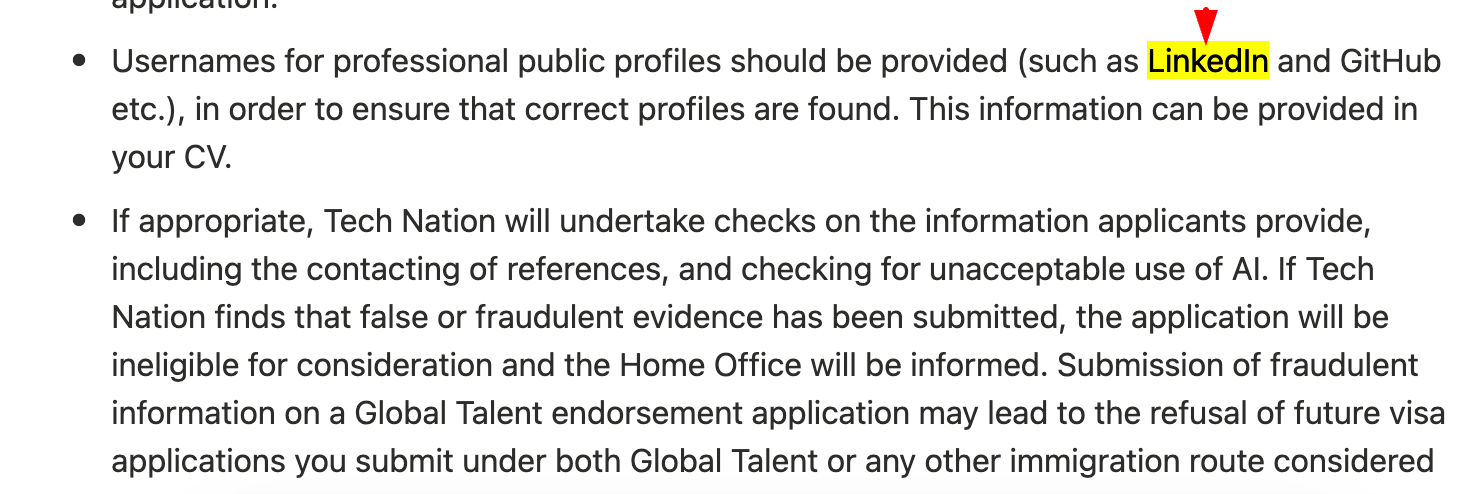
@Sparrow LinkedIn is not considered sufficient as evidence. But should be provided in order to ensure that your correct profile is found. Found for what? Perhaps as part of the assessment process.

And here is how it’s clearly stated on the guideline

Hope this answers the question?

1 Like

Please how about the recommender, He owns a company for over 10 years and He has a linkedin account but dont post on Linkedin although in his profile all his achievment and endorsement are all listed there. He has all his information on his profile. Can his Linkedin profile serve as proof .

@Sylvia

Yes, his LinkedIn profile can serve as proof. Posting on LinkedIn is not a requirement for demonstrating expertise in the tech sector. What matters is the recommender’s professional background. His career history, the companies he has founded or worked with, the positions he has held, and the achievements and endorsements listed on his profile. These elements clearly show his experience, credibility, and trajectory in the industry, which is sufficient to establish him as an expert.

1 Like

Thank you so much @Raphael

Hi @Raphael, is there a way I can send a message to you to guide me regarding the appeal?

Is it free, or do you charge for that? If so.

How is it done?

@logrocket Kindly click on my name “Raphael” to send me a direct message or via tech-pal.co.uk

Yes! It is 100% free if you ask me a question on this forum. I will try to respond if I can or other experts could. But it’s paid if you contact me directly.

2 Likes

Thanks for sharing this, it’s been inspirational reading these and following your corrections.

1 Like

Hello @Raphael, please the concern of LinkedIn not being sufficient as evidence may be referring to posts the applicant made themself?, what about instances where a recognized expert such as someone from Microsoft references your work, shares it with their audience, and gives you credit. While I understand that LinkedIn is often viewed primarily as a job board, the platform extends well beyond job applications and functions as a professional community for industry recognition and engagement.

@Donatus You made a fair point, but the issue is this, a LinkedIn mention on its own isn’t strong enough to prove that someone is a leading talent in the digital technology sector. It can support your case, but not a standalone evidence.

If an expert highlights your work, that’s great, but Tech Nation will still want to see the actual evidence behind that recognition. What exactly did you do? How does it meet the criteria? The mention is only a pointer; the real substance has to come from the work itself and how well it aligns with your narrative and chosen criteria.

2 Likes
