Promise Rejection/Appeal

Hi,

Hope this finds you well.

I applied for Tech nation promise and it got rejected across all criterias.

Below is my application and rejection letter.

Is it worth to appeal or re apply?

Any suggestion will be much appreciated.

Thanks so much

Mandatory Criteria (MC)

MC Evidence 1

• Co-Founder & CSO of STEAM Minds (AI-powered immersive STEM learning platform using AI adaptive learning + Unity/Unreal VR labs).

• startup Won Innovator Seed Fund (ISF) Prime Minister Award Grant (Education Technology category) – USD 35,000 from HEC Pakistan & World Bank.

• Selected as 1 of 15 startups from 144 shortlisted.

• Robotics-World (original product) evolved into STEAM Minds.WSalam

MC Evidence 2

• Selected for Time2Scale 2025–2026 Estonian Cohort (Interreg/EU-funded Central Baltic programme) – 1 of 8 international teams; completed International Business Scaling Program.

• Represented STEAM Minds at Slush 2025 (Helsinki), TechChill 2026 (Riga), and Web Summit 2025 (Vancouver) as ALPHA with booth.

MC Evidence 3

• Early career as teacher; founded Robotics World with DIY robotics kits (assembly, coding, sensors, automation – beginner to advanced).

• Evolved from hands-on kits in national schools to full VR labs.

• Supporting Facebook posts/videos of early work and student engagement.

MC Evidence 4

• Partnership with NAVTTC (Government of Pakistan) since 2020 under PM Youth Skills Development Program.

• Delivered fully funded training in AI, Immersive Learning, 3D Animation, Digital Marketing, Python, Game Development to 1,500+ students with satisfactory results (letter from DG Planning & Development).

• Supporting recommendation from Anas Niaz (Founder/CEO Bioniks – Forbes 30 Under 30, Industry 4.0 / assistive tech).

Optional Criteria 1 (OC1) – Product innovation & impact

OC1 Evidence 1

• Led product strategy & technical development of STEAM Minds offline-first VR Labs (photorealistic curriculum-based science labs for schools with unstable internet / no physical labs).

• SLO-based curriculum mapping to international standards.

• Built complete LMS + interactive VR labs + real-time performance monitoring.

• USP: cost-effective practical STEM education.

• Technology stack diagram + student photos (chemistry/physics VR labs at Modernage College).

• Robotics World also delivers Scratch, Python & DIY robotics courses.

OC1 Evidence 2

• Signed MOUs with schools, government & international bodies (reached 5,000+ students).

• Key partners: Tulsa Regional STEM Alliance (USA), Orbit School (Swabi), GIKI (IT/e-commerce training), Modernage Public School & College (Abbottabad).

OC1 Evidence 3

• Audited financials (Robotics World & STEAM Minds) show combined annual revenue ≈ PKR 10 million (£26,000).

Optional Criteria 2 (OC2) – Contribution beyond day job

OC2 Evidence 1

• Presented research paper “Impact of Gamified Learning on Cognitive and Neurological Development of K12” at IEEE-sponsored ICETT 2026 (proceedings published, awaiting IEEE Xplore).

• Invited speaker at ICET 2026 – paper “Assessing the Need and Academic Opportunity for Low-Cost, Accessible Virtual Reality in UK Secondary STEM Education” (also accepted at ICMETL, Møller Institute, Churchill College Cambridge).

• Presented “Using AI in Teaching: Opportunities & Realities” at Samarkand State Institute, Uzbekistan.

OC2 Evidence 2

• STEM Ambassador (National STEM Learning Centre – UKRI-funded) & Inspiring the Future volunteer.

• Piloted “Future Week” workshops at Whitehall Primary School; supporting STEM Club launch at Stonehill School (reaching 200+ UK students).

• Invited to Industry Advisory Board, Department of Computer Science, Women University Swabi (Pakistan).

OC2 Evidence 3

• Supporting letter from co-author Dr Ayesha Anees Zaveri (UniKL Malaysia) confirming joint research paper on low-cost accessible VR for UK secondary STEM education (to be presented at ICMETL Cambridge) and its alignment with UK education priorities / STEM attainment gap.

Supporting Recommendation Letters

• Abdullah Soomro (Project Director, Prime Minister’s National Innovation Award, HEC Pakistan) – confirms 5+ years observation, 50+ schools, 5,000+ students / 100+ teachers, ISF award, international accelerators, strong fit for Exceptional Promise.

• Hira Wajahat Malik (Time2Scale Programme Manager / Junior Research Fellow, Estonian Business School) – confirms product focus on constrained environments, scaling maturity, alignment with UK STEM priorities.

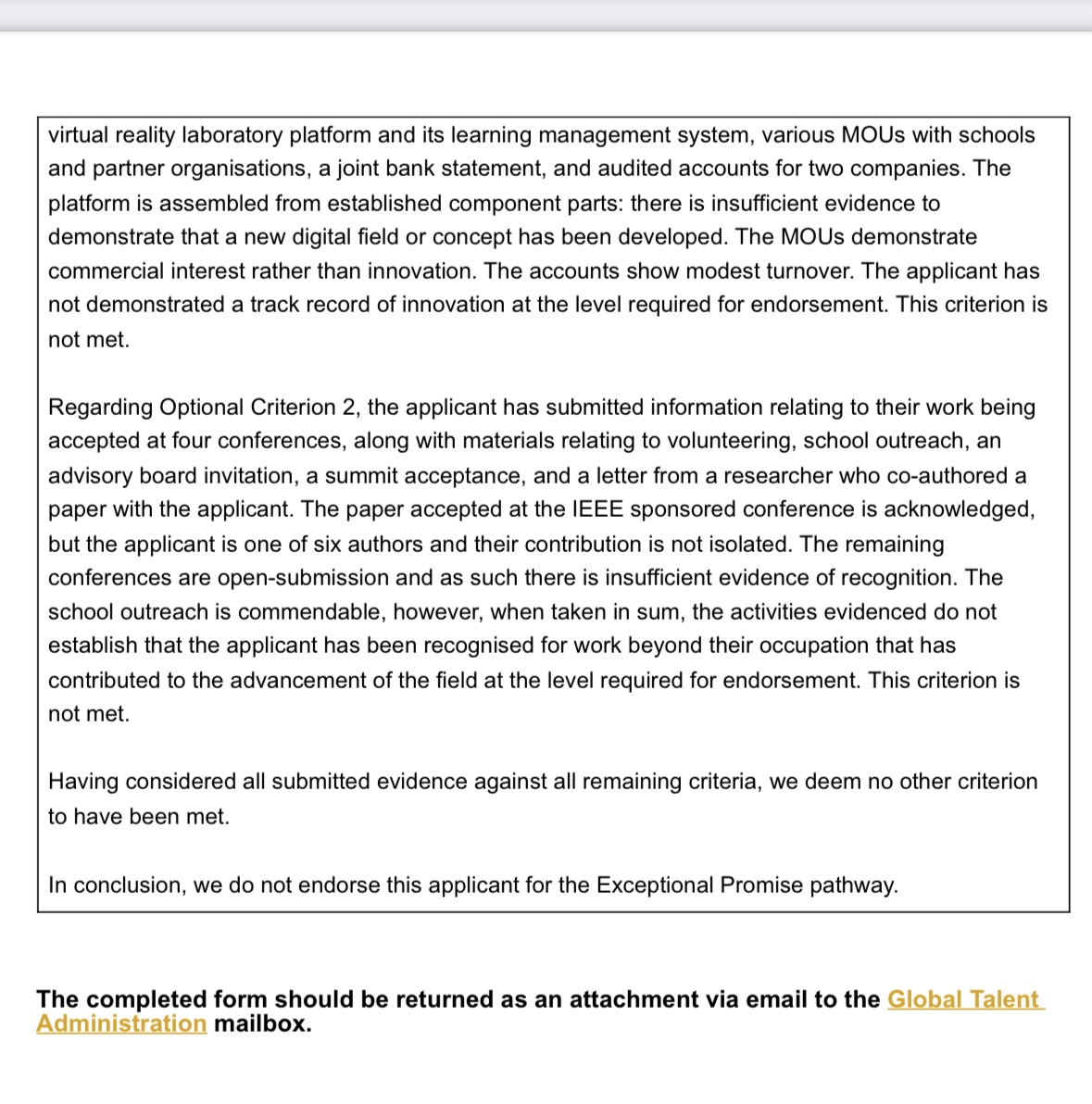
Rejection email:(Reason)

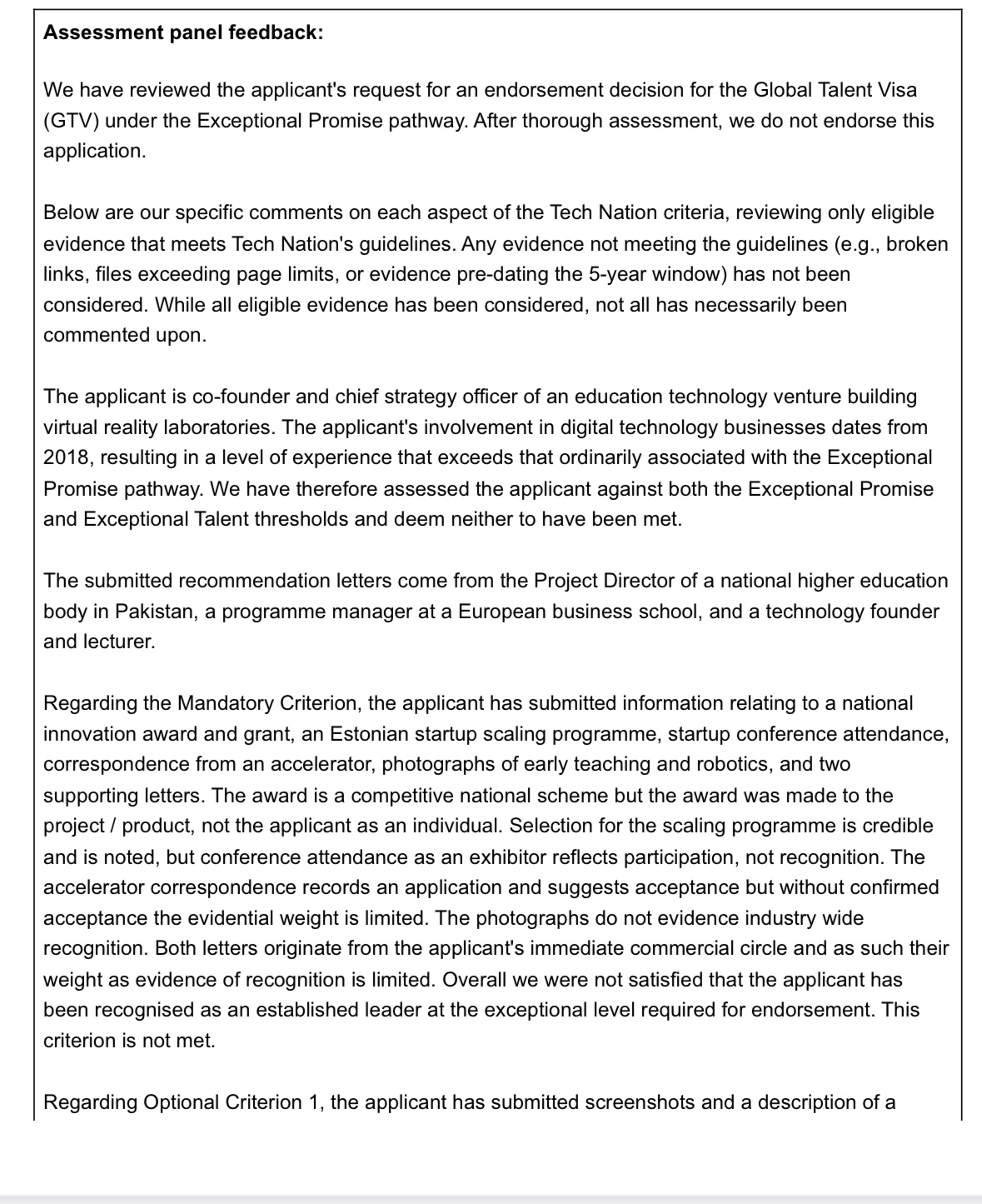
Assessment panel feedback:
A review only helps if the panel made a procedural error or overlooked something you actually submitted. It can’t take new evidence and won’t re-weigh what the panel already considered. Since you were refused across every criterion, the likely cause is how the evidence was framed, so reapplying with it reworked is the stronger route.

Most of your Mandatory set points at the venture rather than at your own standing, and that’s the pattern worth checking. The ISF Prime Minister Award and the 1-of-15 cohort selection recognise STEAM Minds and its potential. An assessor reads that as backing for the startup, which leaves your personal recognition in the field unproven. Founder coverage clustered around the application date compounds the problem, because Mandatory looks for standing the field gives you independently of the company, sustained over time.

The test I’d apply to each Mandatory piece is whether it would still recognise you if the company disappeared tomorrow. An award judged on you as an individual clears that bar; a company milestone written up in the press does not. Post the actual panel feedback and one of the advisers here can pin down which criteria are worth rebuilding first.

Thanks so much for the feedback.

Its like a bit unfair refusal to me.

The ISF awarded to startup but the main idea and making it happen was me i was the driving force and its competitive and on national level.

And yes i participated in conference but my startup was selected as ALPHA startup, with dedicated booth. And the letters they mentioned as commercial circle isn’t, one of it was government body and written by a director which i (startup)am partnering with. And the orher was from a founder forbes 30 u 30.

And the accelerator they mentioned i was selected but after registering company as on current visa i cant.

Regarding OC1, they said platform is assembled from established component parts, its not years back in pakistan its a real innovation with offline capability, and syllabus based Virtual Reality labs. And the bank statement which although is modest but its real and the school MOUs i attached, as they asked in the guidelines.

And for OC2, i have 1 paper published in IEEE, and yes 6 authors but research always have co authors to validate and gather more data,

My 2nd paper was accepted after double blind review. And volunteering at 2-3uk schools which imoacted 200+ students.

Can you please review it.

Thanks :folded_hands:

Your evidence do not meet the current bar for tech nation endorsement. It needs to be clear that you are a recognised leader in your field, the mandatory criteria does not prove this in a convincing manner. 2020 evidence are outside the five year period. The type of competitive cohort programmes were considered in previous years for promise. Regardless, you can ask for a review but your clearly do not qualify for exceptional promise as you have more than 5 years experience. Also the evidence for innovation does not show it is novel and the value of the audited report at 26k does not show substantial revenue. For Option criteria 2, the evidence are quite week, lettrs are not sufficient to meet the criteria.

Thank you for the feedback.

There is no evidence of 2020, the startup was 2018 but that time it was just a side thing with teaching. All my evidence are after 2023.

I applied for promise, not talent.

For oc2 yes i provided 1 letter who was my co author too, but with it i submitted 2 more evidences, my research paper and volunteering at schools and the supporting letter

Based on the information provided, the refusal appears to be less about the number of activities and more about whether the evidence, taken together, demonstrated the level of recognition and contribution required under each criterion.

For MC, the main issue is not simply the amount of activity or the applicant’s involvement in recognised programmes; it is whether the evidence demonstrates that the applicant personally has been recognised as a potential leader at the level required for Exceptional Promise. The ISF award, international programmes and government partnership are useful evidence of activity and achievement, but the assessor appears to have looked for stronger evidence that you personally are recognised as a potential leader in digital technology, rather than primarily recognising the startup, programme or organisation. The international accelerator participation and events such as Slush/Web Summit can support the overall story, but participation alone does not necessarily establish individual recognition.

For OC1, the panel’s concern was that the evidence showed a functioning VR/LMS platform, commercial interest and modest turnover, but did not sufficiently demonstrate that the product represented genuine innovation rather than an implementation assembled from existing components. However, the evidence needs to establish what was technically or commercially innovative, your personal contribution, and evidence that the innovation has been adopted or had meaningful impact. MOUs, student numbers and revenue can support this, but they do not by themselves prove innovation. The copyright certificate should also be treated as supporting evidence rather than proof of innovation on its own.

For OC2, your research presentations, STEM volunteering, teaching and advisory activities are relevant to contribution outside your occupation. The important distinction is demonstrating a contribution to the wider digital technology ecosystem, rather than simply demonstrating professional or educational activity. Evidence showing independent invitations, your specific contribution, audience/impact and recognition by the organisations involved is therefore important.

On the recommendation letters, the seniority of the writers is useful, but the letters should primarily corroborate your achievements and explain why your work demonstrates the relevant criterion. A recommender’s credentials do not substitute for independent evidence of the achievement itself.

Regarding appeal versus reapplication, the distinction is important. An endorsement review is intended to address an error in the original decision or a procedural issue; you cannot introduce new evidence during the review. The review must normally be requested within 28 days.

Therefore, if your refusal simply reflects the panel’s assessment that the existing evidence did not meet the criteria, and you now have stronger evidence that was not submitted originally, that would generally point towards a fresh application rather than trying to use an appeal to introduce improved evidence.

Given the information you’ve provided, I would suggest you first map each refusal reason against the exact evidence you originally submitted. If you can identify a specific document that was overlooked or a factual/procedural error, that is the type of issue relevant to a review. If the problem is principally the panel’s assessment of the strength, relevance or attribution of the evidence, the more appropriate route is usually to rebuild the relevant criteria and reapply.