Looking for honest feedback on my Global Talent Visa – Exceptional Talent profile

Hello everyone,

I am preparing an application for the UK Global Talent Visa in digital technology under the Exceptional Talent route, and I would appreciate honest feedback on whether my profile appears strong enough, especially for the Mandatory Criterion.

My background is in full-stack software engineering, IoT platforms, backend systems, data processing, and applied AI. I have around ten years of experience in digital technology, including technical and co-founder experience before moving to the UK.

Since moving to the UK approximately two and a half years ago, I have:

  • completed postgraduate study in Artificial Intelligence;
  • secured a permanent full-stack engineering role in digital product development;
  • contributed to a UK sustainability-focused digital platform used across a major infrastructure sector;
  • received a salary increase after moving from a fixed-term to permanent position;
  • published a peer-reviewed paper on IoT, machine learning, smart buildings, and energy optimisation;
  • presented related research at an academic conference;
  • become a London chapter lead for an international AI community;
  • helped organise two in-person AI events, including one hosted at a major technology company’s London venue;
  • chaired an AI event featuring several technical speakers;
  • co-organised a large London engineering community;
  • participated in a structured global mentoring programme for women in data;
  • appeared in an interview and published feature about careers in data and technology.

For Optional Criterion 3, I plan to submit evidence of significant technical contributions to two commercial IoT platforms. My work included backend microservices, APIs, telemetry pipelines, device orchestration, cloud integrations, database design, analytics, authentication, CI/CD, and frontend/mobile development. The platforms have real users, connected devices, production telemetry, and measurable operational outcomes.

For Optional Criterion 4, I plan to submit:

  • a peer-reviewed journal publication;
  • evidence of my individual research contribution;
  • a conference presentation;
  • an academic expert letter confirming the originality and practical value of the research.

My three recommendation letters are expected to come from:

  • a senior UK technology leader familiar with my recent work;
  • the founder and CTO of an IoT technology company;
  • a former co-founder who worked with me for several years.

My main concern is the Mandatory Criterion. Much of my recent public recognition and community activity happened after I became established in the UK, so several of these activities are relatively recent. Before moving to the UK, I had stronger founder and technical experience, but some of the older achievements fall outside the most recent five-year period.

I would be grateful for feedback on the following:

  1. Does this profile look more suitable for Exceptional Talent or Exceptional Promise?
  2. Is my Mandatory Criterion likely to be considered strong enough?
  3. Would salary progression, a permanent UK technical role, community leadership, event chairing, research publication, and senior recommendation letters collectively demonstrate recognition?
  4. Are OC3 and OC4 the right optional criteria for this profile?
  5. What would you consider the biggest weakness or rejection risk?

I am not looking for reassurance. I would genuinely appreciate critical feedback from applicants, endorsers, or anyone familiar with successful and unsuccessful digital technology applications.

Thank you.
1 Like

With ten years of experience, Tech Nation will assess you as Exceptional Talent regardless of which route you select. They move applicants with 5+ years automatically, so the ET vs EP question is settled.

MC is the main risk. The community chapter leadership, event organising, and mentoring participation are emerging recognition, but for Exceptional Talent the Official Guide expects “sustained national or international recognition” that “places them at the forefront of their respective field.” Salary progression and a permanent role won’t count toward MC. The published interview could help if the outlet is editorially selective, but you need at least one piece where the recognition came to you unsolicited.

OC4 is structurally clean. OC3 depends on whether the commercial impact from those IoT platforms is externally verifiable. If the only proof of users and outcomes comes from internal dashboards or employer letters, assessors will treat it as self-documentation. Happy to do a proper review of the evidence documents if you want to book a call.

1 Like

Based on what you’ve shared, your profile appears to have a well-rounded combination of commercial engineering experience, research, and community engagement. The overall structure seems logical, but as with most Global Talent applications, the strength of the case will depend on how convincingly the evidence demonstrates the specific criteria and how effectively the portfolio presents a consistent narrative.

For the Mandatory Criterion, this is the main risk area. A permanent role, salary increase, and technical responsibility are positive, but they do not by themselves prove recognition. Your strongest MC evidence seems to be community leadership, event chairing, published interview, and any third-party proof of your influence outside work. These will be much stronger if supported by metrics, invitations, attendee numbers, and independent letters.

Your publication is valuable, but it is usually stronger for OC4 than MC Citations, industry interest, practical adoption, or wider recognition- those aspects may further strengthen its overall impact within your portfolio.

OC3 looks like a strong fit if you can clearly show your individual technical contribution to the IoT platforms. Evidence such as architecture ownership, pull requests, product metrics, and senior testimonials would help a lot.
OC4 also seems appropriate. A peer-reviewed paper, conference presentation, proof of your contribution, and an academic letter should make a solid case, as long as the focus is on your individual originality and impact.

The biggest risk is that your MC evidence may look like career progression rather than external recognition. You need to show measurable influence in the wider tech ecosystem, not just participation. Timing is another issue, but older achievements can still help if they support a clear career narrative.

Overall, I think the application is realistic, but MC needs the most work. OC3 and OC4 look well aligned with your background. If you have a founder experience, technical leadership, and community impact can be evidenced strongly, Exceptional Talent is possible; otherwise, Exceptional Promise may be the safer route.

1 Like

For my current Mandatory Criterion evidence, I have included:

  • Significant technical contributions to a nationally important sustainability-focused digital platform used across a major UK infrastructure sector. Although my employer is not a product-based company, I played a key role in the development and delivery of this large-scale digital solution.
  • Recognition of my technical capabilities through securing a permanent Full Stack Developer role following an initial fixed-term appointment.
  • Evidence of career progression and impact, including a salary increase associated with my transition to a permanent position.
  • Public speaking engagements within the technology community.
  • Community leadership activities.
  • Mentoring and supporting aspiring technology professionals.

In addition, I am the founder of a technology consultancy company. Would this be suitable evidence for the Mandatory Criterion, and if so, how would you recommend demonstrating its technical impact and relevance to strengthen my application?

Yes, your technology consultancy could strengthen your Mandatory Criterion, but only if it shows external recognition and real impact, not just company ownership.

Assessors are likely to care about outcomes. So, if your consultancy has delivered digital products, solved technical problems, or built solutions for clients, it can support your case. I would suggest that the evidence should show your direct role in designing or delivering the solutions instead of how you manage projects.

It will be much stronger if you can show measurable impact, such as contracts with recognised clients, revenue growth, repeat business, live platforms, production systems, user numbers, cloud or AI/IoT solutions, and client testimonials.

Independent evidence such as letters from clients explaining why they chose you, what you solved, and the impact of your work will carry more weight than self-written material. Media coverage, awards, accelerator places, partnerships, or speaking invitations linked to the consultancy would also help.

I would not rely on your permanent role or salary increase as main MC evidence. These show progression, but not necessarily external recognition. Use them as supporting evidence alongside your stronger achievements.

If the consultancy is new or has limited traction, I would suggest not to make it the main MC point. You can use it to support your wider profile. But, if it has clear technical achievements and client impact, it could become one of your strongest documents.

1 Like

@fateme_mosleh

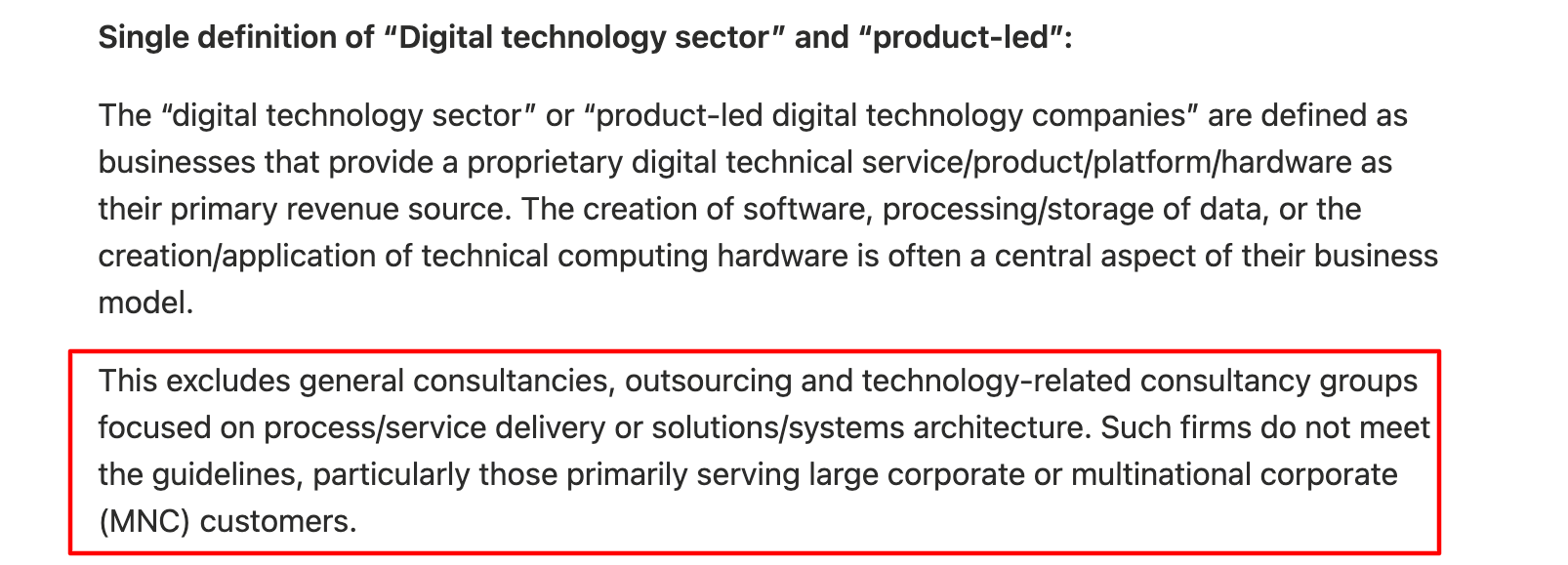
Consultancy companies, be it technical or management side role are generally not considered suitable for Tech Nation application. Also, your evidence as the founder of a technology consultancy company is also not suitable for MC criterion, because as a founder you are required to show how you led the growth, team product or company direction of a product led, digital technology company and because, product led company as defined by the guidance excludes general consultancies, outsourcing and technology related consultancy groups focused on process, service delivery or solutions, systems architecture.

My honest suggestion, avoid mentioning anything consultancy anywhere in your application.

All the best,.

1 Like

Based on your years of experience you are eligible for exceptional talent.

How recent are your evidence? 1-3 years or just 2026?

I think it’s important I give some context here to help you and others who might read this thread later and who may want to base their application decision on this.

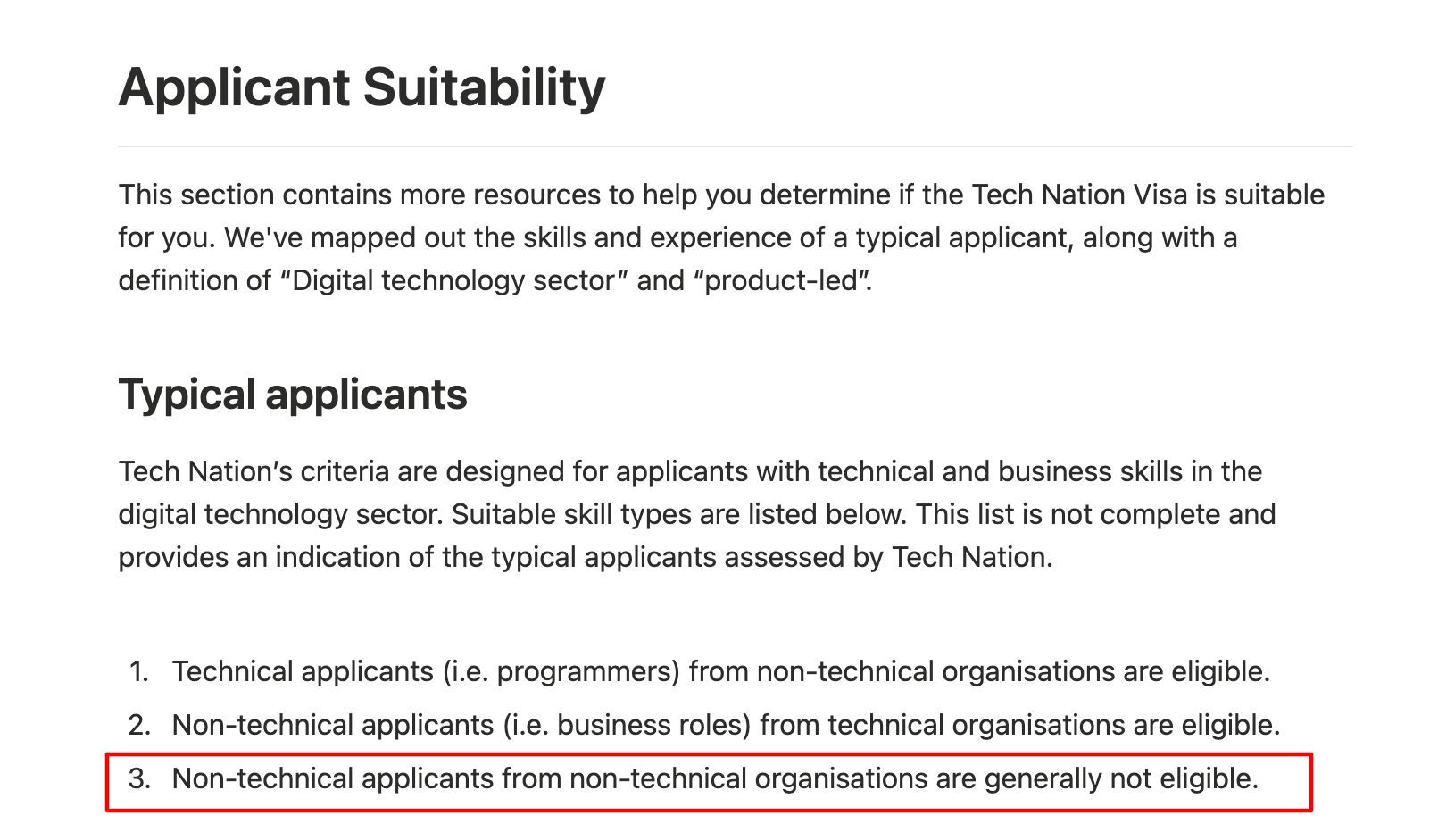
You see eligibility is not only about years of experience. This can only determine an applicant’s pathway - Talent or Promise. Eligibility is primarily based on your discipline and where you currently work or have worked in the last five years. And here is how Tech Nation put it

You said “In addition, I am the founder of a technology consultancy company. Would this be suitable”

As you can see your company does not appear to meet the definition of digital technology sector” and “product-led from the Tech Nation guidance quoted above.

C Suite in a SMEs + (CEO, CMO, CIO)/Founder which is under the business role working in a non technical role is as well not eligible.

image

However, there could be a work around. If you have worked in a tech company in the last five years, or you simply position yourself as full-stack software engineer, and present the non consultancy department of your company. Also, you can safely choose OC2 and OC4 that has nothing to do with product led or technology company where an applicant worked. For MC too there are evidence like speaking, substantial contribution to open sources, these are not dependent on where you work, if presented strategically you can be fine as regards eligibility and how the evidence meet the criteria.

All the best.

1 Like

My paper and my talks are for February 2026 however previously in 2025 I had an abstract paper but most of my activities started around January 2026 however I’m in a uk for 2.5 so I would say 1 year of study and then based on that started my activity do you think is it acceptable?

Evidence all clustered inside the six months before submission is the specific pattern the Official Guide flags as unacceptable, describing evidence made solely to support the timing of an application as inadmissible. If everything meaningful started in January or February 2026 and the application goes in during 2026, the assessor sees a coordinated build rather than sustained recognition. Sustained means the activity existed before you decided to apply, not just that it exists when you apply.

The practical fix is spreading evidence across a longer arc. Push the application into 2027 if timing allows. Another year of chairing events, mentoring cohorts, and citation accumulation on the paper starts to look like a genuine track record rather than a burst. The paper and talks aren’t undermined by being from Feb 2026; they’re undermined by everything else being from the same window.

If you can bring in pre-UK founder work as continuous professional background, that anchors the narrative in a longer timeline even if some of it falls outside the strict 5-year window for individual evidence pieces. The recent activities then read as continuation of an existing career rather than a debut.