One of the questions I hear a lot as a Tech Nation application consultant is: “How do I present my evidence so it is not termed as self-authored?”
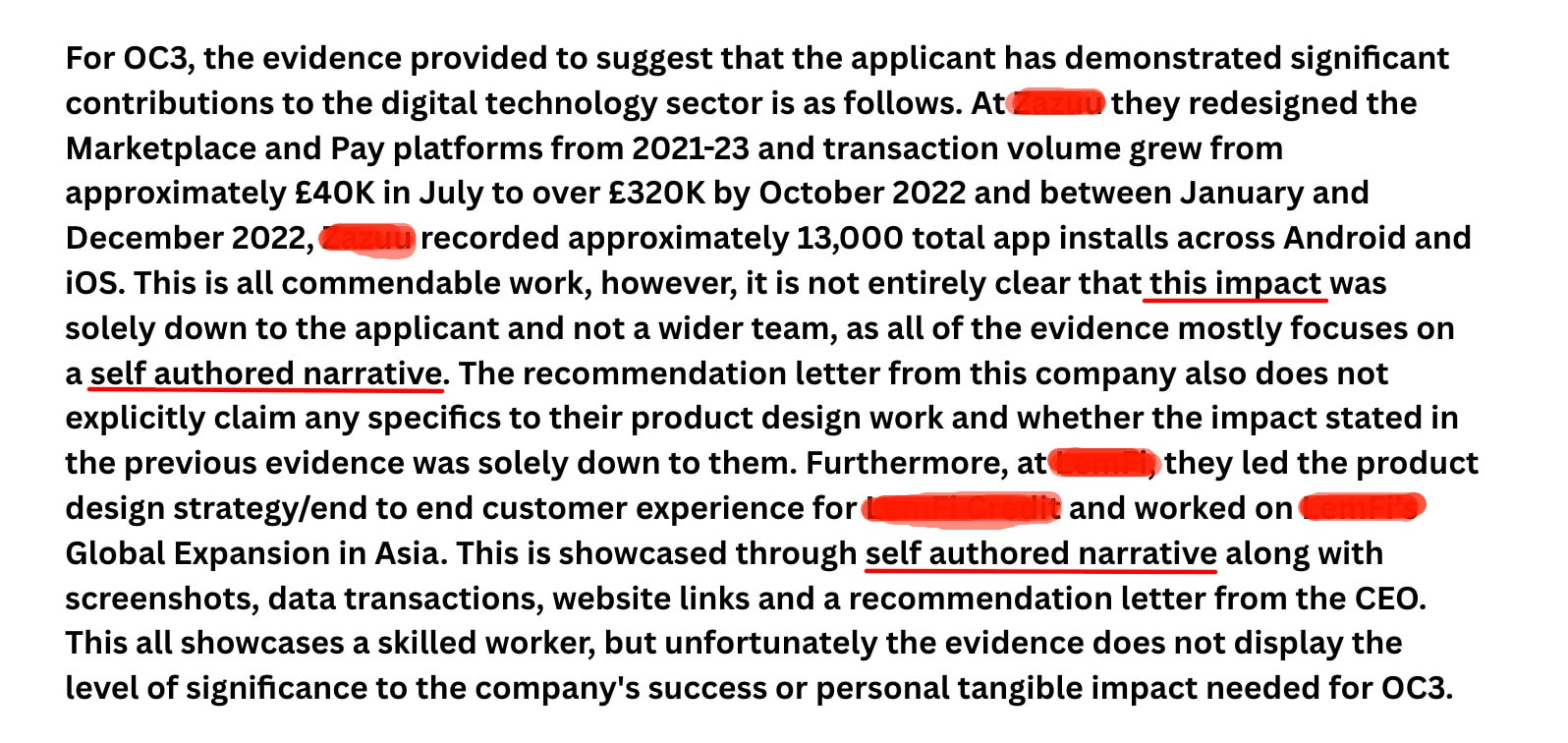
This concern is genuine. Apart from the product-led issue assessors raise regarding OC3 which I wrote about in my last post: Why OC3 Means Product-Led - And Why It Makes or Breaks Your Application, another common rejection reason I see all the time for OC3 is self-authored narrative and showing team impact instead of personal impact
Let’s break down what these terms actually mean and how you can strategically navigate them to drastically increase your chances.
- What “Self-Authored” Really Means
A document is labeled self-authored when the assessor feels you wrote the entire story yourself without any independent, third party proof to validate it.
Imagine walking into a bank for a loan and telling the manager, “I make £100,000 a year, trust me.” Even if it’s 100% true, the bank won’t accept it because you declared it yourself. They need official bank statements, pay slips, or tax documents. Similarly, writing a pretty 3 page evidence claiming “I redesigned the app and grew revenue from £40K to £320K” is treated as a self declared claim until backed up by official company data, analytics, or leadership sign offs.
- What “Personal Impact vs. Team Impact” Means
Assessors flag this when you quote massive, company wide growth figures, but fail to isolate what part of that growth came directly from your hands versus the wider engineering, design, or marketing teams.
This is how I explain it to applicants who consult me. Imagine a football team wins a match 3 - 0. If the striker puts. I won the match 3 - 0" on their profile, it completely ignores the goalkeeper, defenders, and coach. To prove personal impact, the striker must say: “I scored 2 of the 3 goals, made 5 key passes, and played all 90 minutes.” In Tech Nation application, claiming credit for 13,000 total app downloads is a team metric., showing that your specific onboarding redesign reduced user drop-off by 40% is personal impact.
How to Strategically Navigate These to Increase Your Chances
A. Disambiguate “My Work” vs. “Team Work” : Before quoting big numbers, explicitly carve out your specific slice of the work.
B. Employment / Contract Scope Proof : Don’t just attach a generic employment contract. Extract lines from your performance reviews, OKR/KPI trackers, or contract scopes that hold you individually accountable for specific outcomes.
C. Code / Repository Analytics (For Tech Roles) : A standard screenshot of a product or codebase doesn’t prove who built it. Include a screenshot of the repository’s Contributors page on GitHub/GitLab showing your commit volume relative to the team, alongside pull request review sign offs and lines of code contributed.
D. Get Explicit Third-Party & Leadership Attestation: You can turn a self authored document into an official, verified record by linking it directly to company authority. But not with a reference letter like with generic praise like “Raphael is an amazing product designer who helped us grow” Your letters from Executives must explicitly state your direct contribution. Like
“I confirm that Raphael led the end to end redesign of the payment platform mentioned in his contribution to Tech-Pal evidence. The transaction volume growth from £40K to £320K was directly driven by his UX overhaul, which cut abandonment in half, the outcome of his significant contributions aided the marketing team’s efforts to increase sales drastically”
E. Include Executive Sign Offs Directly on Documents : If you submit an evidence with your internal company work, without external validation, then never submit it as an unverified document. Add an executive sign off block at the end, or attach an email/Slack confirmation from your C level executive or direct line manager verifying the claims.
-
An Example of Sign-Off Block at the bottom of your evidence can look like :
Executive Verification
“I confirm that I have reviewed this document as regards Raphael’s claim of his contributions to Tech-Pal. The technical designs, features, and impact metrics detailed above accurately reflect Raphael’s individual work and primary contribution at Tech-Pal.”
Name: Lagbaja Kolawole, Founder
Work Email,WhatsApp Number: lagbaja.kolawole@company.com
Signature & Date
Final Tip for Your Tech Nation Application
Always ask yourself when using an internal document: “If an assessor reads this, can they tell where my work ends and the team’s work begins?” If the answer is no, add the manager sign off, isolate your individual metrics, and get that third party validation in place before submitting.
All the best.