GTV Digital Technology Application Review for – MC + OC2 + OC3

Hi everyone, I’m preparing an Exceptional Promise application under MC + OC2 + OC3 and would appreciate feedback. I’ve kept the focus mainly on scale, measurable impact and independent validation rather than technical detail.

MC – Recognition

MC Evidence 1 – Publication A: major national news publication
Independent editorial feature in a major national news outlet with 2M+ estimated monthly website visits, covering my 6+ year engineering career, AI/open-source contributions and community impact. The feature also highlights my initiative to introduce secondary-school students to technology careers and responsible use of AI, including a completed school session and further outreach in progress.
Images: published article + journalist byline, publication reach/traffic metrics, photograph from secondary-school technology/AI session + school acknowledgement

MC Evidence 2 – Publication B: leading African technology publication
Independent feature focused on my career journey from oil & gas into software engineering, the decisions and learning required to make that transition, navigating layoffs and career uncertainty, and how that journey eventually led into AI/MCP and open-source contribution. The story would position the technical work within a broader narrative of career reinvention, resilience and contribution to the technology ecosystem.

MC Evidence 3 – Technical speaking recognition
Invited speaker at a major technology community event hosted at University A, one of the country’s leading universities, where I delivered a technical session on AI/MCP to 500+ attendees.
Images: official event listing showing me as speaker, event/venue evidence showing University A, photos/video of me speaking to the 500+ audience

OC2 – Contribution outside paid employment

Evidence 1 – Organisation A: major developer ecosystem
Built and contributed to an AI communication protocol (MCP) using a developer platform with 190k+ GitHub stars. The work resulted in 2 merged contributions to the official AI protocol working-group repository, with public maintainer review and approval.
Images: developer platform showing 190k+ GitHub stars, merged contribution #1 + maintainer acknowledgement, merged contribution #2 + maintainer approval

Evidence 2 – Organisation B: major AI protocol ecosystem
A separate standards/interoperability contribution merged into the official repository for Model Context Protocol (MCP) by Anthropic. The organisation’s official TypeScript SDK has 13.5k+ GitHub stars and 2.2k+ forks, with its Python SDK at 24k+ stars. My contribution was independently reviewed and accepted by maintainers and also supported a related upstream specification proposal.
Images: organisation/repository scale metrics, merged contribution + maintainer approval, upstream specification proposal

Evidence 3 – Organisation C: international engineering research publication
Published original research on conversational commerce using MCP-enabled AI assistants in an international peer-reviewed engineering and technology journal. The paper is 10 pages long, has a permanent Crossref DOI, and is indexed/discoverable through platforms including Google Scholar, OpenAlex, Semantic Scholar and OpenAIRE. The research reported a 0.21 mean price-dispersion index and estimated 22%+ potential savings on popular electronics through cross-marketplace comparison.
Images: article first page showing title/authors, DOI + publication/indexing page, results/architecture page showing the 0.21 price-dispersion and 22%+ savings findings

OC3 – Significant contribution in employment

Evidence 1 – Company A: global consumer technology platform
Company A operates within a global group with approximately 100,000 employees across 130+ countries and serves close to half a billion consumers/pets globally. My evidence focuses on consolidating 2 regional platforms – US and UK – into one platform.
Images: company scale/market footprint, before-vs-after platform structure, traffic/SEO impact graph

Evidence 2 – Company A: analytics + experimentation impact
Consolidated duplicated regional analytics infrastructure, reducing ongoing maintenance overhead by 50%+, while experimentation work produced approximately +1.98% improvement in email-registration success and +0.66% increase in registration starts.
Images: before-vs-after analytics setup, experiment/uplift graph, leadership confirmation attributing the work to me

Evidence 3 – Company A: AI innovation
Built an internal AI integration that received the organisation’s “Most Innovative Use of AI” award.
Images: working product/demo, internal award announcement, leadership confirmation

Would this evidence mix now look sufficiently strong and coherent for MC + OC2 + OC3 ?
@Akash_Joshi @Raphael @Noddy

The MC case is the main risk. The Guide asks for sustained or emerging national or international recognition, with activity across the past five years. Two independent features may help, but the key question is whether they recognise you personally as an emerging leader in digital technology, rather than mainly describing your work or the wider ecosystem. The speaking evidence can add weight if the event and your role are independently established.

OC2 has a coherent shape, but the contributions need to show an ongoing record of voluntary work that advanced the field. The Guide distinguishes that from work done while representing a company or its products, so make the context and your personal contribution clear. For OC3, connect your individual work to the platform’s outcomes; company scale and an internal award do not establish your impact by themselves.

I’d prioritise the personal-recognition case for MC, the sustained voluntary contribution for OC2, and attributable product impact for OC3.

You have some good evidence for OC2 and OC3. However, can you confirm the timing of this evidence? How recent are the contributions, publications and employment examples, and do you have a track record of activity across multiple years?

At the moment, I don’t find the Mandatory Criterion particularly compelling. The articles may help demonstrate recognition, but I’m not sure they are sufficient on their own to establish you as a recognised leader in the sector.

If some of the OC2 evidence relates to significant open-source projects, I would consider moving one of the strongest open-source contributions to the Mandatory Criterion, particularly if it demonstrates recognition by established organisations.

Thanks, this is really helpful.

On timing, my professional engineering track record spans several (4-5) years, while most of the external/open-source activity is more recent and concentrated within roughly the last 6–12 months.

  • Employment/OC3: my relevant work spans roughly 2023–2026, including domain consolidation work, experimentation, analytics and AI-related product work.
  • AI/open-source/OC2: I started exploring MCP/AI integrations around late 2025, with the more substantial public contributions happening throughout 2026. This includes multiple independently reviewed/merged contributions to the official ecosystem, an interoperability/standards contribution and a published research paper.
  • Speaking/community recognition: invited technical talk in May 2026 to 500+ attendees, followed by technology/AI outreach to secondary-school students in October 2026.

So I agree that I wouldn’t describe the OC2 work as a multi-year contribution yet. My thinking was that, as an Exceptional Promise applicant, it shows an emerging and increasingly consistent pattern of contribution rather than a long-established track record.

On MC, thanks for the feedback. I’m currently strengthening the personal-recognition side through independent national media coverage and the speaking/community evidence.

Well, from proforma feedback shared on the forum, recent evidence does not show. a track record.. May and October 2026 speaking may be close to the timing of your application.

Overall: strong and coherent for Exceptional Promise but OC3 is your weakest link.

  • MC: Solid. Two independent features + invited speaker at a major university. Ensure features are genuinely independent, name you, and aren’t paid PR. One more external recognition would help.

  • OC2: Very strong. Merged MCP/Anthropic contributions with maintainer approval, plus a peer-reviewed indexed paper. But the paper fits OC4 better. Consider OC2 + OC4 if OC3 feels weak.

  • OC3: Weakest. Internal platform consolidation and small uplifts (+1.98%, +0.66%) can look routine. 50% maintenance reduction and AI award help. Get harder business impact: revenue, users, cost saved, or external validation.

  • Red flags: Minor contributions, predatory journal, internal-only evidence.

  • Verdict: Likely strong enough for Promise if you strengthen OC3. If the paper is solid, consider OC2 + OC4 instead.

@Oluwatobi_Oyewole Trust you are good.

For Mandatory Criteria (MC), Tech Nation typically expects a publication centered on your specific work that has advanced the sector, or independent media coverage that directly validates your expertise. Looking at your career feature covering your 6+ year engineering journey, AI or open-source contributions, and community impact, it feels more like an article sharing your story rather than third party media independently validating your work. Why was the article written? Was it because the media was celebrating top achievers and invited you as a major tech contributor over the last 6 years, or did you reach out to share your story? Articles like this are often viewed as advertorials by assessors.

Similarly, the article in the African technology publication focuses on your transition from oil and gas to tech, which highlights your personal journey rather than sector wide impact. Since both articles are similar, you should group them together under MC 1 Evidence (Media publication). However, keep in mind that these currently are weak MC evidence.

Regarding your technical speaking engagement, speaking recognition can be helpful, but a university talk generally does not qualify as a top tier or high profile digital tech sector event unless it was organised or backed by tech giants (for example, a Google University Conference) where the host/partner brand elevates its status. While the evidence you listed is useful, you need to clearly show the recognition element. An official invitation letter, email, or a reference letter from the organisers would help validate your recognition and contributions.

On OC2, when you mention Organisation A, was this work done for a company, and was it paid work? If it was unpaid, you need to state that explicitly. Once OC2 evidence is linked to a commercial entity, assessors might assume it was part of your paid job unless clearly stated otherwise Your open source contributions with maintainer code reviews look promising, but make sure to show your direct contribution clearly, including code commits with your name visible as the author. High project metrics like 190k stars are good background context for adoption, but your main focus should be on your specific code contributions and the direct recognition or acknowledgement you received from the maintainers. For Organisation B, are these public open source ecosystems? OC2 works best when the activity is completely outside a paid employment setup. Showing ongoing contributions helps demonstrate continuous impact, but you must highlight your individual impact beyond general repository metrics.

You might also find my article on OC2 on how to clearly show recognition and impact helpful

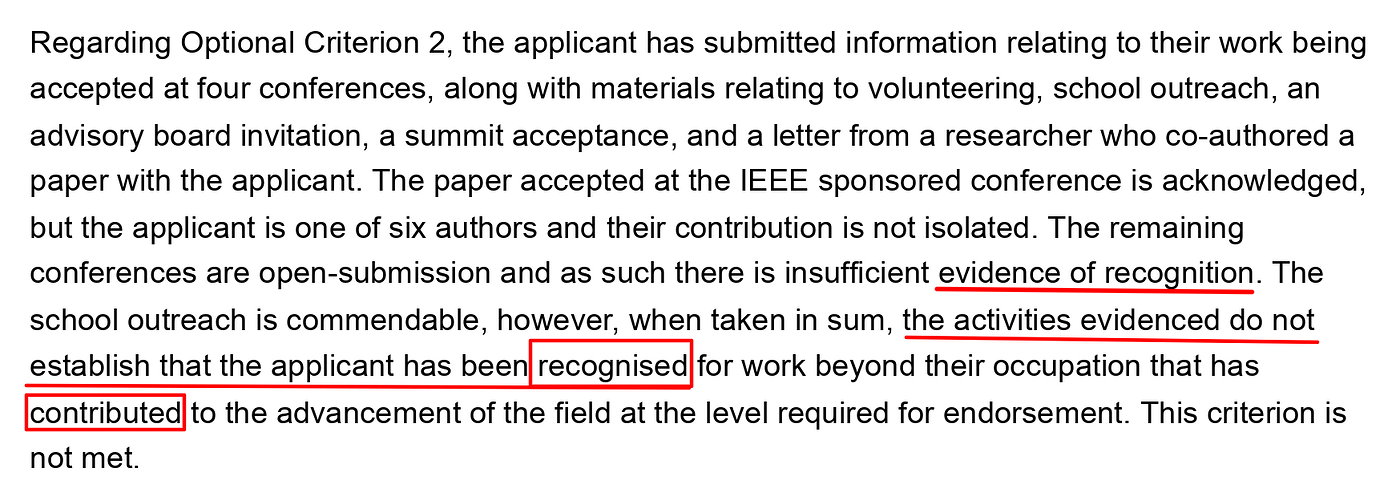
On your international engineering research publication, this would be much stronger under OC4. Under OC2, Tech Nation checks for both recognition and broad sector impact, whereas OC4 focuses specifically on demonstrating exceptional ability through academic or research contributions. In OC4, the chance of acceptance for research papers is significantly higher because recognition is not a primary requirement there. Don’t take my word for it. Here is a recent feedback

If that applicant had used their research under OC4 instead, the issue regarding recognition likely would not have been raised. I suggest moving this paper to OC4 if you can, keeping in mind that you need just two OCs overall.

For OC3, focus heavily on your direct technical contributions rather than the company profile. First, ensure the companies are product led digital technology company. The evidence you listed, such as market footprint, platform architecture, traffic, and SEO impact, are useful supporting details, but they are not your primary artefacts as a software engineer and do not directly prove significant technical contribution on their own. Start with your core engineering work (such as code, technical architecture with your name, or complex systems built, correspondence with technical partners), and then validate it using reference letters, awards, performance benchmarks, and experimentation results.

On your question about whether this evidence mix is sufficiently strong and coherent for MC + OC2 + OC3

As it stands, MC looks a bit weak, OC2 has potential if presented strategically, and the research paper fits better under OC4. For OC3, ensure the companies are product led and shift the focus to your technical execution rather than general business metrics. Overall, you have some good evidence, but I suggest doing an alignment check, then get at least one strong evidence and rightly aligned evidence for each criterion to increase your chances.

All the best.