Global Talent Exceptional Promise refusal — looking for opinions on whether an appeal is worthwhile

I applied for the Global Talent Visa under the Exceptional Promise route and unfortunately received a refusal from Tech Nation.

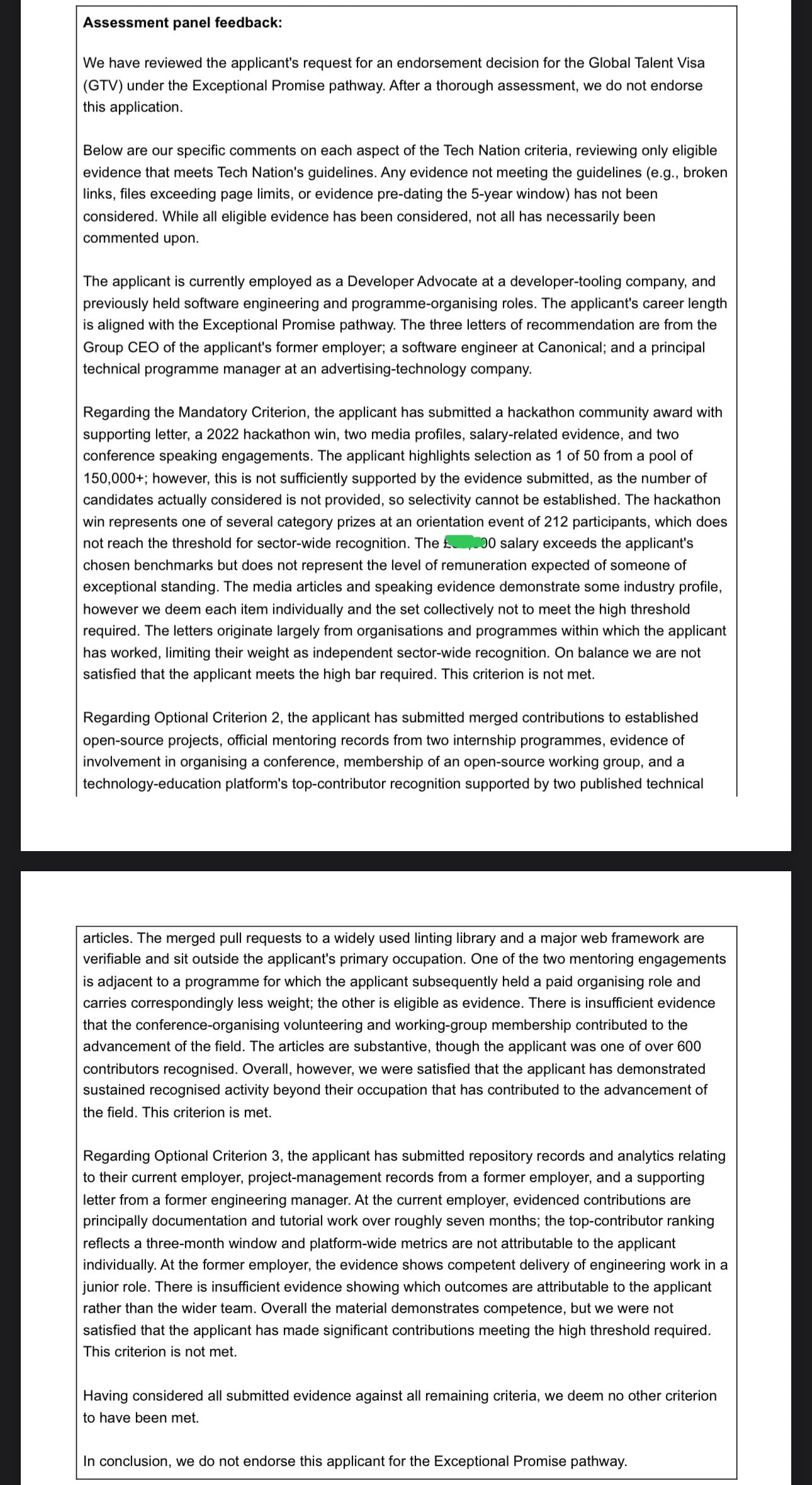
I was successful on Optional Criterion 2 (OC2), but was unsuccessful on the Mandatory Criterion (MC) and Optional Criterion 3 (OC3).

I’ve attached the feedback I received.

After reviewing the decision alongside the evidence I submitted, I am considering submitting an appeal.

I’d really appreciate an honest assessment from people who have experience with Global Talent applications/reviews, particularly whether the issues below could potentially provide grounds for a review, or whether I would be better off making a fresh application with stronger evidence.

My application

I applied under Exceptional Promise, with evidence covering open source, software engineering, developer advocacy, technical speaking and community/mentoring work.

Mandatory Criterion

My evidence included:

Recognition from a major global developer community organisation

  • Selected as one of the organisation’s Top 50 developers/hackers of 2025.
  • Submitted my official profile for the recognition.
  • Submitted a supporting letter from a senior leader at the organisation who oversees the Top 50 programme.
  • The letter described the selection process and the size of the organisation’s developer community.

Media recognition

  • Two media features covering my work in software engineering, open source and developer advocacy.

Speaking

  • Speaking engagements at Berlin Buzzwords and OSCAFest.

Salary

  • Evidence of my current salary as a Developer Advocate, together with UK salary benchmarking.

Award

  • Evidence of winning a hackathon organised by the same major developer community organisation.

Recommendation letters

I submitted recommendation letters from three main recommenders:

  • Group CEO of my former employer, a technology company where I previously worked as a software engineer.
  • Principal Technical Program Manager at a major advertising-technology company, with previous experience leading developer outreach programmes at a major open-source foundation.
  • Software Engineer at a major Linux/software company, with extensive experience across open source, developer communities and technical programmes.

I also included additional recommendation letters from senior people in the developer and open-source ecosystem.

OC2 — Accepted

For OC2, I submitted evidence including:

  • contributions to a widely used JavaScript linting project;
  • a contribution to the Django project;
  • substantial contributions to an open-source civic/environmental technology project;
  • 350+ pull request reviews;
  • 160+ issues created to help first-time contributors get started;
  • Google Summer of Code mentoring;
  • Outreachy mentoring;
  • technical writing for a major developer education publication;
  • recognition as a top contributor to that publication;
  • other open-source/community contributions.

OC2 was accepted.

OC3 — Not accepted

For OC3, I submitted evidence from both my current employer and former employer.

Current employer

I submitted evidence of my individual technical contributions to documentation, tutorials and developer-facing resources, including:

  • merged pull requests;
  • repository/commit history;
  • contributor activity;
  • analytics showing usage and engagement with documentation/tutorial content I contributed to.

The evidence covered approximately seven months of work.

Former employer

I submitted internal project-management records and contributor analytics showing my individual ownership and completion of substantial engineering work on a cloud software platform.

This included work involving:

  • automated unit testing in the CI/CD pipeline;
  • GitHub and GitLab integrations/webhooks;
  • RabbitMQ queues and consumers;
  • GitHub branch-search improvements;
  • production monitoring and APM;
  • production alerting across multiple application flows;
  • Opsgenie/Slack alerting.

The project-management records identify me as the assignee for the relevant tasks and show them as completed.

What I’d particularly like advice on

1. Top 50 recognition and the Mandatory Criterion

The reviewer questioned whether the selectivity of the Top 50 recognition was sufficiently established.

I submitted both the official profile and a recommendation letter from a senior leader at the organisation who oversees the Top 50 programme, which explains the programme and its selection.

Could this potentially be a point worth raising in a review?

Or is the distinction between the size of the organisation’s developer community and the number of people actually considered for the Top 50 a reasonable basis for the panel’s conclusion?

2. Recommendation letters

The panel also appears to have placed limited weight on my recommendation letters because they came from organisations/programmes where I had worked or contributed.

Given the backgrounds of my three main recommenders — particularly the senior programme leader with extensive open-source/developer-outreach experience and the software engineer from a major Linux/software company — would people consider this a potentially reviewable issue?

Or is it normal for the panel to place limited weight on recommenders who know the applicant through programmes they participated in or organisations they previously worked with?

3. OC3 — individual contribution vs impact

This is probably the area I’m most unsure about.

I provided evidence showing that I personally owned and completed specific engineering work, combined with internal project records, contributor analytics and senior-level recommendations.

For my current employer, I also provided repository evidence and analytics relating to documentation/tutorial work.

However, the panel considered this evidence to demonstrate competence rather than significant contribution, partly because the broader outcomes could not be attributed solely to me.

For people who have successfully applied under Exceptional Promise, does this seem like a reasonable interpretation of the evidence?

Or is there potentially an argument that the evidence demonstrated individual technical contribution, particularly given the combination of project ownership, completed work, contributor analytics and senior-level corroboration?

4. Appeal vs reapplication

Given that OC2 was accepted, while MC and OC3 were rejected, do I have a shot at appeal, or would you consider this better approached as a fresh application with stronger evidence?

Thank you in advance for your help!
@Akash_Joshi @Raphael I’d appreciate your thoughts on this!

Both the selectivity question and the recommender weighting are judgement calls the panel was entitled to make on the material in front of them. A Tech Nation review only succeeds where the panel made a procedural error or overlooked evidence you actually submitted, and it cannot re-weigh evidence they did consider, so an appeal is a weak lever here. With OC2 already cleared, a fresh application rebuilding MC and OC3 is the stronger route.

The Mandatory Criterion came down to independence. A Top 50 profile and a letter from the person who runs that same programme both sit inside the organisation that recognised you, so the panel had nothing independent to judge the selectivity against. The Guide wants recognition that would still stand if your own network were removed from the picture. An individually judged award with public selection criteria, or media naming you as a figure in the field, gives the panel that anchor.

A competence-not-contribution verdict almost always means the outcomes could not be attributed to you specifically. Project records showing you as the assignee prove you did the work. What OC3 tests is whether that work moved something the wider field would notice, so pair the ownership with an external outcome others can verify, such as adoption figures or a launch that was covered publicly.

@Akash_Joshi Thanks, this is really helpful. I think the difference between challenging the panel’s weighting of evidence and identifying evidence they actually overlooked is particularly useful.

One thing I’m still unsure about is the Mandatory Criterion point. The recommendation letter I submitted was from a senior leader who actually oversees the Top 50 programme, and the letter explicitly explains that the recognition is a deliberately narrow selection of 50 people from a developer community of 100,000+. The panel nevertheless said that the number of candidates actually considered wasn’t provided and therefore the selectivity couldn’t be established.

Would that potentially qualify as an overlooked/misunderstood piece of evidence for a review, or would the fact that the evidence came from someone within the organisation still make this purely a judgement call?

Similarly, for OC3, I understand the distinction between proving that I personally did the work and proving that the work had significant impact. I’m wondering whether the combination of individual project ownership, internal project records, contributor analytics and senior-level corroboration could be enough to argue that the panel overlooked the significance of the work, or whether that would also just be considered a disagreement with their assessment.

I’m trying to determine whether there is a genuine review ground before deciding whether to go straight to a fresh application.

The letter does explain the selection, so the panel did read it. Their finding was narrower than that: it addressed community size, not the candidate pool. 100,000+ is how many people are in the organisation, whereas selectivity is measured against how many were actually assessed for the 50 places, and that shortlist figure is the one the letter didn’t give. A deliberately narrow pick from a large community can still be a narrow pick from ten serious candidates or ten thousand, and the panel had no way to tell which. That is a gap they identified in the evidence rather than one they missed, which keeps it outside review territory.

Having the recommender inside the programme deepens the same problem. The one number that would have settled selectivity is coming from the person who runs the recognition, so there is nothing external for the panel to check it against.

OC3 works the same way once you separate what each piece proves. Project records, contributor analytics and senior corroboration all point at the same thing, that the work was yours. None of them speaks to whether the work mattered beyond your team, and significance is the bit OC3 tests. Stacking more attribution evidence deepens the ownership case but leaves the impact case where it was, so the combination lands with the panel the same way each piece did on its own. A fresh application built around one OC3 outcome an outsider can verify moves the needle in a way an appeal on this material won’t.

@Akash_Joshi Do you mind if I DM you?

@tosin_fatai possible to share the timeline for your application? i’m awaiting my decision so asking

Submitted my documents on Aug 25th

Referred on Aug 31st

Decision arrived on Sept 14th

oh wow, mine was forwarded on aug 20, i submitted on july 29 and i still have no update

@tosin_fatai Regardless of the feedback, I’d encourage you to appeal. It doesn’t cost anything with Tech Nation, and you stand to gain more clarity and guidance for a possible reapplication if the appeal doesn’t go through.

You also won’t get meaningful feedback if you only provide a high level description of your evidence. Beyond listing and descriptions, Tech Nation looks at the context behind each piece of evidence and how well it aligns with their guidance.

All the best.

The MC issue seems to be that the application presented the recognition as “Top 50 of 150,000+”, but the evidence did not clearly establish that 150,000+ people were actually considered for that particular ranking. If you have documentary evidence from the awarding organisation that clearly confirms the eligible or selection pool, the selection process, and your position within it that could potentially provide a basis for raising the point in a review.

However, if the 150,000+ figure only refers to the size of the organisation’s wider developer community, rather than the number of people actually considered for the Top 50 recognition, then simply highlighting the size of the community is unlikely to address the panel’s concern.

The more difficult point is OC3. The refusal does not say the technical work was invalid; it says the evidence did not demonstrate impact at the required level or clearly attribute the outcomes to the applicant. The current-employer evidence was mainly documentation/tutorial work over around seven months, while the former-employer evidence demonstrated competent engineering work but not outcomes that could clearly be separated from the wider team. If you have no additional evidence from the original application that directly contradicts those findings, a review is unlikely to be the strongest route. For OC3, the focus should be on projects where you can clearly show what you personally designed/built/decided, why your contribution was significant, and what measurable result followed from it, ideally supported by independent or externally verifiable evidence.

The project-management records, GitHub/GitLab history and analytics can help establish individual involvement, but they need to go beyond demonstrating that tasks were completed. The strongest evidence would connect your individual contribution to a clear and measurable organisational, technical or commercial impact.

So, based on the issues described in the refusal, I would approach it this way:
Consider a review if you can identify a clear factual or assessment error in the evidence that was already submitted — particularly if the existing documents actually establish the Top 50 selection pool or directly address the panel’s concerns.

If there is no such error and the main weaknesses are the strength of the evidence, attribution of impact, or lack of sufficiently significant outcomes, I would lean towards reapplying with stronger and more targeted evidence rather than trying to argue the same case again.
The fact that OC2 was accepted is encouraging because it shows that the panel recognised your contribution to the field. The next application would need to build on that strength while addressing the specific gaps identified for MC and OC3.

Hello @tosin_fatai

Hope you are doing good!

Thanks for sharing your journey. I am interested to know your OC2, as I too am planning to pick mentorship as OC2.

Can you share how you showed mentorship to secure OC2.

Thanks

Hi @Pratibha_Sharma, I was a Google Summer of Code mentor.