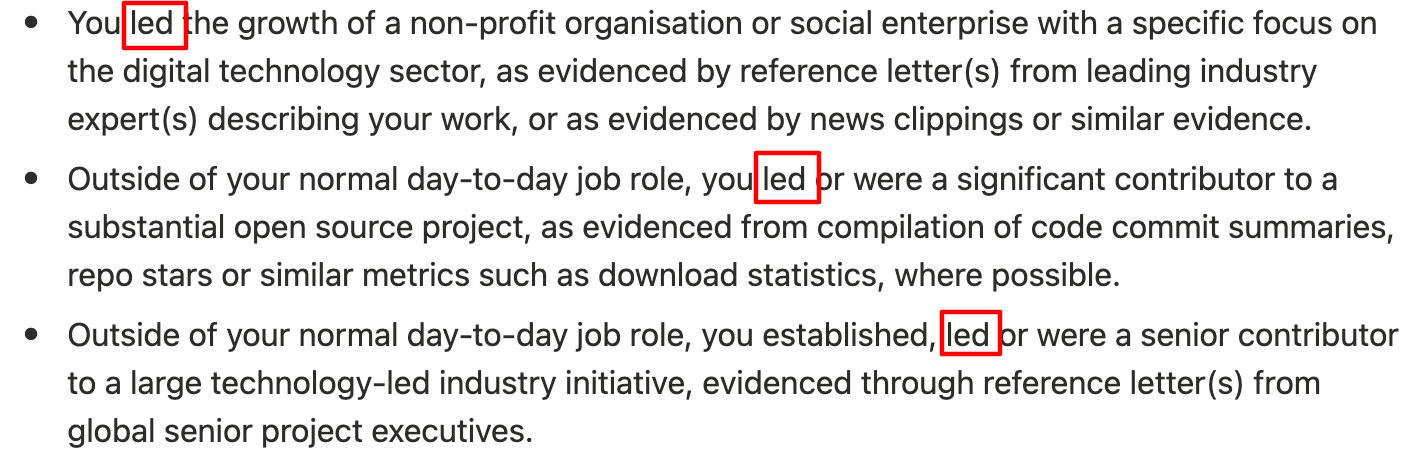
Hi @oluwatosinolamilekan I hope you don’t mind me asking, but why exactly are you strengthening your profile by publishing technical articles, building open‑source projects, and increasing your public contributions. Unless you’ve applied before and already got other criterion, and you are just focusing on these. Most of what you’re doing leans heavily toward contribution to advancing the sector, outside paid role. This is fine if it’s done properly. But what about the other criteria that also need to be met. You need to understand your narrative clearly and have a structured, strategic plan for how you intend to gather evidence across all areas to increase your chances.
On your evidence listing, freeCodeCamp is ok, but whether your article actually meets the criterion depends on other elements, for example, whether it came as a result of recognition, the editorial process (which is fine), whether it’s a genuine thought leadership piece, whether the topic is relevant to the sector, and whether you can show impact such as readership, comments, and so on.
What are the titles of the articles you submitted to platforms like DZone, LeadDev, The New Stack, InfoQ, WeAreDevelopers, and the others. Ideally, you should have one evidence set for something like OC2 – Contribution to the Sector (Thought Leadership), but you won’t be able to put more than three or four publication pieces into that single set. You may end up writing many articles you can’t even use. You can’t put articles in OC2‑One and OC2‑Two, because each evidence set must be unique.
A Chrome extension for a Laravel package can be useful, but you need to work on adoption, that means downloads. Planning a conference talk doesn’t show recognition unless it’s structured, partnered with reputable organisations, and you can show it’s sustained. Not just planning, but actually organising successful, sector focused events.
On your question:
How much weight do multiple editorial publications carry if they are spread across different respected technology publications?
Just 2–3 sector relevant, focused articles in reputable journals are fine. It’s not about quantity at once, it’s about whether it’s sustained. Publishing 100 articles in one month is not the same as having 10 solid ones over three years. Sustained contributions over time carry more weight. It also helps to list the topics, reach, and impact because simply publishing is not enough to meet any criterion. So, this will help me check other elements.
If some article submissions are still under editorial review at the time of application, should I wait until they are published before applying?
Tech Nation only assesses evidence based claims. Also, your focus seems too heavy on just getting articles published. There are other important elements they look for, as I mentioned above.
For open‑source evidence, is it more persuasive to focus on download numbers alone, or should I also include GitHub activity, release history, documentation, and community engagement?
Everything matters. All of it makes your evidence more believable.
How valuable are TV interviews, podcasts, or conference talks compared with published technical articles for demonstrating recognition under the Mandatory Criterion?
It depends on the context. Were you invited. Were you approached as an expert. Were you a keynote speaker. What type of journal. A reputable academic publication can be more relevant than a local radio interview.
Looking at my current progress, would you continue investing time in additional publications, or shift focus toward speaking engagements and media appearances?
Unless you already have the other criteria settled, what you’re doing is very heavy on OC2. What about MC and the remaining criterion. The strategy should be to list everything you want to work on for each criterion. Have one very strong, undisputable piece of evidence for each, these will be your leading evidence and others will be complementary, then you work on them simultaneously.
For context
MC
Evidence 1(Very strong, undisputable )
Evidence 2 ( Complementary)
Evidence 3 ( Complementary)
Evidence 4 ( Supplementary)
OC2
Evidence 1 (Very strong, undisputable )
Evidence 2 ( Complementary)
Evidence 3 ( Complementary)
OCX
Evidence 1(Very strong, undisputable )
Evidence 2 ( Complementary)
Evidence 3 ( Complementary)
The guidance states that you must meet one MC and two OCs
MC Evidence 1(Very strong, indisputable ), OC Evidence 1(Very strong, indisputable ), OCX Evidence 1(Very strong, indisputable ) If these are indeed undisputable, then you have the required 3 already to be endorsed. Then you still have the complementary and supplementary to support them.
I am yet to see any applicant who got endorsed with 10 perfect evidence. Some even submit 6, 7 evidence. But trust me they got the undisputable 3 factors, complementary and supplementary evidence.
So, if you don’t have the major 3 yet, that’s where you should start from, along side your articles.
All the best