Hi everyone, I want to seek advice on my appeal attempt
I was denied for stage 1 (Exceptional Talent)
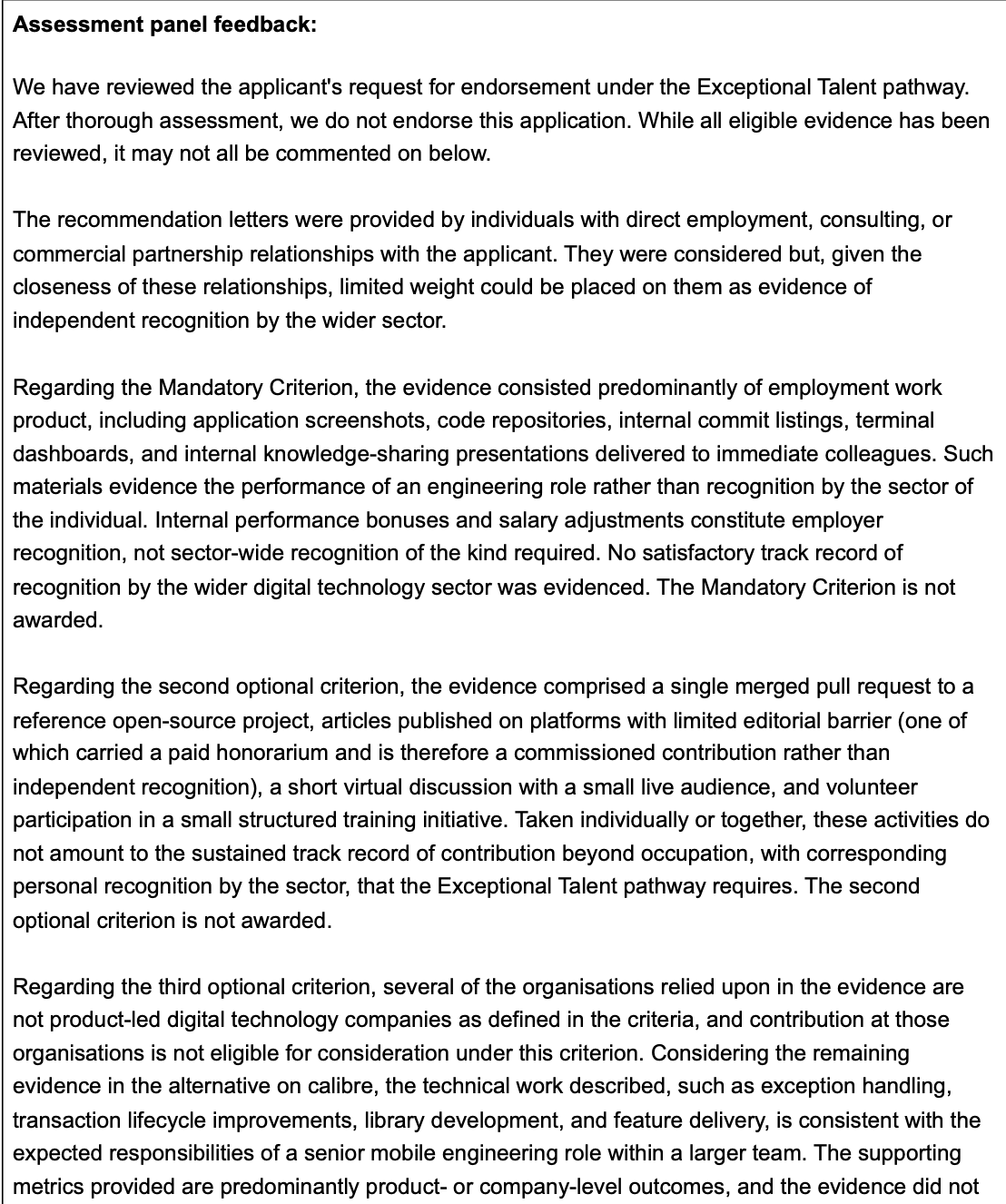
This my appeal draft
For the recommendation letters
The panel’s characterisation of my recommendation letters as lacking independence due to prior professional proximity appears inconsistent with the published guidance. The criteria requires recommendation letters from leading industry experts. Applying a blanket discount based on professional familiarity risks misapplying that standard.
Each recommender is an established senior figure in the technology sector whose standing extends beyond any professional interaction with me. I do not currently have any employment or commercial relationship with any of them.
The first recommender is a senior technology executive(CEO and CoFounder) and Global Talent Visa recipient with more than fifteen years of experience in software engineering and technology leadership. While I previously contributed to products connected to organisations he founded, his recommendation was not a manager’s reference. It reflected an independent assessment of my technical and architectural contributions across multiple products over several years.
The second recommender is the founder and chief executive of a well-known technology company operating within the African digital ecosystem. Although our paths crossed during a previous engagement, his recommendation was not based solely on that interaction. He also evaluated my work through a separate commercial integration involving two independent organisations. His endorsement therefore reflected an arm’s-length assessment of work delivered through a business relationship rather than a direct reporting line.
The third recommender is a senior technology consultant with extensive experience leading software engineering and digital transformation initiatives. My engagement with him was project-based rather than employment-based. His recommendation reflected an independent assessment of my contributions to a technology platform and also referenced activities beyond direct delivery work, including mentorship and talent development.
In the digital technology sector, recommendation letters frequently arise through professional collaboration across products, organisations, and ecosystems. Prior professional interaction should not, on its own, diminish the independence or credibility of a recommender. If such a standard were applied broadly, it could significantly narrow the pool of eligible industry experts capable of providing informed assessments of an applicant’s contributions and impact.
For the mandatory
The panel’s rejection appears to misapply the published Mandatory Criterion and does not assess the evidence against the routes explicitly described in the guidance. The guidance states that leadership within product-led digital technology companies may be demonstrated through evidence such as expert reference letters, media recognition, code contributions, and high remuneration. Evidence was submitted across each of these categories, yet the decision appeared to dismiss the evidence collectively without addressing how the individual items align with the published examples.
For company 1, evidence included technical leadership in the development and scaling of a consumer-facing mobile product used by a substantial customer base. Supporting materials included named source-code contributions, technical architecture screenshots, independent national media coverage at launch, an expert recommendation letter from a senior technology leader with recognised standing in the industry, and documented performance-based remuneration.
For company 2, operating across multiple markets, evidence included ownership and delivery of key product features, independent media coverage, and documented salary progression linked to measurable performance outcomes.
For company 3 evidence included technical architecture contributions, documented source-code ownership, and evidence showing significant growth in business metrics alongside improvements in platform stability and operational performance.
Taken together, the evidence corresponded directly with the categories listed in the guidance: independent press coverage, attributable code contributions, expert endorsements, and remuneration linked to impact. Characterising all of this evidence as merely routine employment activity does not appear to engage with the specific evidential routes identified under the Mandatory Criterion.
For OC2
The panel’s rejection does not accurately reflect the evidence submitted under OC2 and contains material errors in both fact and interpretation. These errors relate directly to how independent recognition beyond my occupation was assessed and materially affect the conclusion reached.
Technical article mischaracterised as commissioned work: The panel incorrectly characterised one of my articles as commissioned work due to a paid honorarium. This is factually incorrect. I independently wrote and submitted the article, which was subsequently selected through a competitive editorial process. The honorarium was awarded after selection and publication; it was not a commission, brief, or instruction to produce content. The article was authored independently and selected on merit by an external editorial team.
Editorial publication mischaracterised as having a low barrier to entry: The panel incorrectly grouped my publication under “limited editorial barrier.” The article was not self-published. I was approached by an editor to contribute the article, and it underwent editorial review before publication. The evidence demonstrates independent editorial selection and validation of my technical expertise beyond my employment.
Community contribution and public engagement mischaracterised: The panel characterised my public speaking and mentoring activities as involving only a small audience and participation in a small structured initiative. The evidence shows that I was selected to contribute to established technical community programmes based on my expertise. I delivered technical training, developed learning materials, mentored aspiring developers, and participated in public technical discussions, demonstrating recognition beyond my day-to-day employment.
Open-source contribution not fully assessed: The panel described my contribution as “a single merged pull request,” which materially understates both the significance of the work and my broader open-source activity. The evidence demonstrates sustained contributions to recognised open-source projects, including identifying and resolving a technically complex issue that was reviewed and accepted by project maintainers. The contribution subsequently resulted in independent engagement from external researchers, further evidencing recognition of my technical expertise beyond my employment.
Taken together, independently selected technical writing, editorially reviewed publications, community mentorship, public technical engagement, and sustained open-source contributions demonstrate a consistent track record of recognition beyond my occupation.
For OC3
The panel appears to have made two assessment errors: first, by treating qualifying product-led technology companies as non-product-led organisations; and second, by failing to properly assess evidence that directly attributed significant technical contributions to me.
For a regulated digital banking platform whose core offering is a mobile-first banking product, the evidence submitted clearly identified my individual contribution through development records, IDE screenshots, and source-code evidence demonstrating my authorship of key mobile banking components, including a chat-based banking interface. In addition, I submitted a demonstration video and a reference letter from the head of operations, both of which directly corroborated my ownership of these features. The assessment does not appear to engage with these materials.
For a fintech product company whose primary offering is a POS and agency banking platform, my evidence included commit history, IDE project evidence, a product demonstration video, and a reference letter from the head of product, all showing my ownership of core transaction-processing and lifecycle-management systems.
The submission also included evidence relating to an NFC transaction library that I independently conceived, designed, and implemented to address a product limitation. Repository ownership and commit history demonstrated sole authorship. Beyond deployment within the organisation, the library was subsequently adopted by several customer organisations within the broader ecosystem, demonstrating tangible product impact beyond its initial implementation and contributing to functionality delivered to end users. The assessment does not appear to engage with this evidence of creation, production deployment, and external adoption.
For a large-scale digital banking platform serving millions of customers through software products, the evidence submitted included sprint-board allocations, source-code evidence, and application analytics data directly linking implemented stability improvements and core modules to my work. These records demonstrate individually attributable engineering contributions rather than general team participation.
Taken together, the evidence demonstrates significant and individually attributable technical contributions across multiple product-led digital technology companies, supported by source-code records, demonstration videos, reference letters, and independent third-party adoption of software I created.
Pls, tell me what you think
@Raphael @Akash_Joshi