Global Talent (Digital Tech, Exceptional Promise): sanity check on my evidence split

Hi all, I’m planning to apply under Exceptional Promise and would love a reality check on how I’ve allocated my evidence. Quick background: product manager, a few years at early-stage startups, early 20s.

MANDATORY CRITERION: led growth of a digital tech nonprofit

  • Co-founded an AI policy nonprofit, mentioned in Tech Crunch and Nature magazine. Not direct mention to my name, but to the non-profit I co-founded.
  • Secured a grant from an established funder; the funder will write a letter confirming I co-founded the org and led the application
  • Letter from the nonprofit’s current president describing my early founding work
  • University publication naming me as co-founder

OC2: work outside my occupation

  • Judge at a AI hackathon sponsored by Cursor and at two events during a San Francisco tech week (these had funded startups, not a student event, with my co-judges being VC partners)
  • Wrote a market report and ran a monthly newsletter for a VC firm, reaching ~1,000 readers (mostly LPs, founders and investors)

OC3: contributions to product-led companies

  • Previous role (US startup, Series C, Unicorn): drove ~$0.5M in cost savings plus churn reductions through multiple projects. Had projects impacting direct activation rate
  • Current role (founding PM at a VC-backed AI startup, joined 3 months ago): led a core product launch

LETTERS: a VC investor, my former head of product, and a serial tech founder. All have known my work for 12+ months.

MY MAIN WORRIES

  1. The nonprofit press covers the organisation, and I stepped back ~2 years ago. Is that strong enough for MC if letters tie me to it?
  2. Are hackathon and tech week judging roles substantial enough for OC2, or do assessors expect bigger stages?
  3. Does newsletter and report work for a VC firm count as “outside my occupation” if I was working with the firm at the time? Is ~1k reach enough?
  4. My current role is only 3 months old. Will OC3 hold up mostly on my previous role?
  5. I also have a few contributor-style articles. Worth including, or do they dilute the application?

Any feedback appreciated, especially from anyone endorsed recently.

Growth of a tech-focused nonprofit is an explicit MC example in Tech Nation’s Guide. The risk is personal recognition: organisation-level press proves its profile, while the university item and funder confirmation can attribute work to you. The president’s letter should detail your role and the sector impact. Keep evidence within the five-year window; stepping back two years ago does not by itself rule it out.

Tech Nation lists significant expert judging under MC, making it a more natural fit than OC2. The 100-attendee floor is for conference speaking, not judging. Show why you were selected, the event’s standing and what you assessed. OC2 separately requires recognised work beyond your occupation that advances the field.

The VC report or newsletter is weak for OC2 if it was part of your work with the firm. The Guide describes OC2 as voluntary, unpaid work outside your occupation and not on a company’s behalf. Reach alone does not show sector advancement. If separate, document that distinction and any independent uptake.

OC3 can draw on previous employment; it need not be your current role. Tie your decisions to impact at a product-led company, separating your contribution from team results. The three-month launch is supporting evidence unless you can verify shipped use or outcomes.

Contributor articles don’t dilute by existing. Keep only the strongest edited, relevant pieces that show recognition or add a distinct contribution. A byline or self-published post alone carries little MC weight. Prioritise personal attribution and keep each claim distinct.

Overall, your structure is sensible but several pieces need careful reframing to meet the “personal recognition” bar.

:face_with_monocle: Mandatory Criterion: The Nonprofit Press

Your concern is valid. Coverage of your nonprofit in TechCrunch and Nature without your name is venture-centred coverage, not personal recognition. Assessors explicitly ask: “Would this recognition exist if the company didn’t?” If the answer is no, it fails MC.

The fix: The funder’s letter and the president’s letter are crucial. They must explicitly state you co-founded the organisation and you led the grant application. The university publication naming you as co-founder helps. This combination can work, but the press coverage alone cannot carry MC.

:balance_scale: OC2: Judging and Newsletter Work

Judging roles: These are viable for OC2. The key is framing. Letters from co-judges (especially the VC partners) must confirm what you personally evaluated, why you were selected as an expert, and the significance of the competition. A generic “he was a judge” letter is weak.

Newsletter and report for a VC firm: This is a significant risk. If you were working with the firm at the time, it may be read as part of your occupation, not outside it. OC2 explicitly requires contributions beyond your day job. The ~1,000 reach is modest but not fatal if the content demonstrates thought leadership. However, the employment relationship is the bigger problem. If this was paid work or part of your role, do not use it for OC2. If it was genuinely voluntary and separate, you must prove that with clear chronology and evidence.

:rocket: OC3: Short Tenure and Previous Role

Your current role (3 months) is too early to carry OC3. That’s fine. OC3 can rest on your previous role if you can prove:

  1. Personal ownership: What did you decide, build, or lead? Not “the team achieved.”

  2. Measurable outcome: The $0.5M cost savings and churn reduction are strong if you can draw a direct line from your actions to those numbers. Your former head of product’s letter must confirm your specific contribution.

  3. Product-led company: The Series C unicorn clearly qualifies.

For your current role, you can mention the product launch as supporting evidence of continued contribution, but don’t rely on it.

:page_facing_up: Contributor Articles

Dilution risk. Unless these articles are in reputable industry publications, name you as the author, and demonstrate thought leadership, they add little. If they’re self-published or on low-credibility platforms, leave them out. Focus on quality over quantity.

:memo: Final Verdict

Your strongest pieces are the funder letter, the university publication, and your previous role’s measurable impact. The nonprofit press coverage needs the letters to do the heavy lifting. OC2 judging is workable with strong co-judge letters. The VC newsletter is a red flag if it was part of your occupation. Drop the contributor articles unless they’re exceptional. Fix the framing and this becomes a much stronger case.

@Emil_Rustamli

As a Product Manager, you would be considered a business applicant. To be eligible, you should generally be working within a technology company.

Regarding age, all adults are eligible, whether they are in their 20s, 30s, 40s, or even 50s. What matters more is how long you have been active in the digital technology sector, as this often influences whether your application is better suited for Exceptional Promise or Exceptional Talent.

Looking at your evidence, the MC is really about recognition of you as an expert, or recognition of work you carried out in an expert capacity.

Being a co founder of an AI policy nonprofit can be useful evidence. The mentions in TechCrunch and Nature are also positive. However, if those publications only mention the organisation and not you personally, the evidence becomes weaker from a recognition perspective. One way to strengthen it is if the platform was recognised for solving a genuine sector problem. In that case, you could provide supporting documents showing your connection to the organisation, such as company registration documents, founding records, emails relating to the product or feature, and other evidence that demonstrates your ownership and leadership role.

Securing a grant can also be valuable evidence. However, a grant mainly validates that the organisation, product, or initiative you co founded or led was considered worthy of funding. On its own, that is not enough. You should also demonstrate your personal involvement and leadership. Show how you led the initiative, your communication with team members, partners, or the funder, evidence of your involvement in the application process, and proof relating to the grant itself. A support letter alone nott sufficient.

A university publication naming you as a founder may also help. However, was the solution or nonprofit university based? Universities are not generally considered media outlets, so any publication from the university itself may carry less weight if presented as media recognition.

For OC2, judging an AI hackathon can potentially fit under either MC or OC2, depending on the circumstances. If you were invited because of your established expertise and the people being assessed were your peers or industry professionals, it may support MC under recognition as an expert assessing the work of others.If the participants were not your peers, it may be more suitable for OC2 as evidence of contribution to the sector.

One thing to keep in mind is that both MC and OC2 involve recognition. The difference is that MC focuses on leadership and expertise, while OC2 focuses on contributions you’ve made to the wider sector as a recognised expert.

Regarding the market report, you are applying as a Product Manager. Ideally, the report should be connected to a product you helped build, manage, or grow. I would present it from that angle rather than making the report itself the main artefact.

Also, VC firms are commercial organisations. OC2 is focused on contributions made outside your normal paid employment that advance the sector. Therefore, you need to clearly explain how the work you did through the VC contributed to the wider technology ecosystem rather than simply supporting a commercial business.

For OC3, the fact that the companies are product led is a good starting point. Raising investment and reaching Series C stage is certainly impressive. However, as a Product Manager, the key question is how you contributed substantially to the success of those products.
Can you provide product strategy documents, roadmaps, customer research, user interviews, market analysis, sprint plans, release records, delivery milestones, activation metrics, adoption results, and similar artefacts that Product Managers typically own?
The stronger your evidence of leadership and measurable contribution to the product’s success, the stronger your OC3 case will be. The same applies to your current role. Focus on showing what you personally did, how you led the work, and the impact of the product launch.

On your main concerns, I believe my feedback above answers them

Hope this helps. All the best.

Thanks so much for taking the time to reply, this is really helpful. If you don’t mind, I have one follow-up on the personal statement.

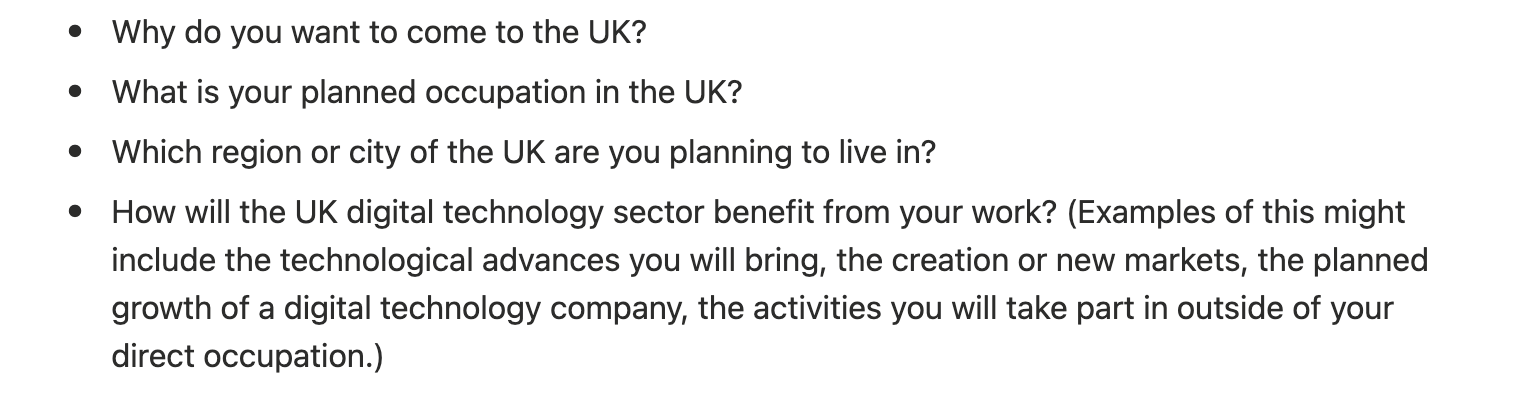
I’m trying to figure out how to approach the 1,000 words on my intentions in the UK and my contribution to the tech sector, since the pieces I have are still mostly forward-looking:

  1. UK hub: If my visa is approved and I move to London, my company would very likely start hiring a team there, with me building out our first international hub and second office outside the US.
  2. Existing ties: I spent time in London as an exchange student during university, and I have friends and connections in the UK, including people running nonprofits.
  3. Community involvement: I’d actively take on speaking, judging competitions, and mentoring startups. Nothing is scheduled yet, so these are intentions for now.
  4. Prior UK activity: The AI nonprofit I co-founded held one of its events in London in 2024, which I attended in person.

My main worry is that I’m not joining a UK-based company or starting my own business here yet* (of course, within our sector and with such startup experience, it’s likely that few years down the line I’d start something of my own or a VC fund). I’d remain with my New York-based employer, so in the short term my UK contributions would be volunteering (speaking, judging, mentoring) and potentially growing the company into the UK by hiring locally.

From your experience, what should I make clearer in the statement so this comes across as a credible contribution to the UK sector? And would assessors expect firmer evidence for the community plans, such as confirmed invitations, or are well-articulated intentions acceptable at the Exceptional Promise level?

Thanks again!

The statement should explain how your current product role could benefit UK digital technology even if the office expansion remains uncertain. Tech Nation’s Guide asks how you will contribute while based in the UK, and says the recommendation letters should describe your future work plans. Treat the expansion as conditional unless your employer has approved it, then explain your own role and what backing exists. Your past UK activity can anchor the plan; personal ties explain your choice of location, but do not establish sector benefit.

Confirmed speaking or mentoring invitations are not listed as a requirement. The Guide asks for future plans and says claims about future impact should have relevant support where possible. Describe the community work you intend to do, mark what is confirmed and what remains aspirational, and include evidence of concrete steps already taken where available. Keep a possible future start-up or fund clearly long-term, not part of your near-term contribution.

Personal statements are primarily about you as an applicant, what you have achieved so far, the impact you have already made, and what you intend to achieve if your application is successful. You do not need to have already done significant work in the UK. Assessors, I believe will look at your track record, career trajectory, and past achievements to determine whether you are likely to replicate and build on that success in the UK.

From my experience, the strongest personal statements are those that are realistic, relevant, and consistent with the applicant’s existing career path and accomplishments then their future plans naturally connect. Also, the statement should answer these questions listed in the guidance.

You may also find my article on the personal statement helpful

All the best.